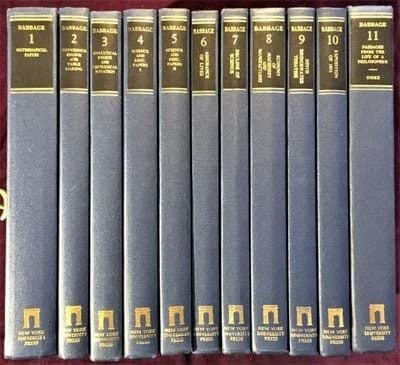
On the Economy of Machinery and ManufacturesBabbage, Charles
ReligionComparative
On the Economy of Machinery and Manufactures
Babbage, Charles
Machinery; Manufactures
In order to shew that this plan of inking puts the proper
quantity of ink upon the type, we must prove, first--that the
quantity is not too little: this would soon have been discovered
from the complaints of the public and the booksellers; and,
secondly that it is not too great. This latter point was
satisfactorily established by an experiment. A few hours after
one side of a sheet of paper has been printed upon, the ink is
sufficiently dry to allow it to receive the impression upon the
other; and, as considerable pressure is made use of, the tympan
on which the side first printed is laid, is guarded from soiling
it by a sheet of paper called the set-off sheet. This paper
receives, in succession, every sheet of the work to be printed,
acquiring from them more or less of the ink, according to their
dryness, or the quantity upon them. It was necessary in the
former process, after about one hundred impressions, to change
this set-off sheet, which then became too much soiled for further
use. In the new method of printing by machinery, no such sheet is
used, but a blanket is employed as its substitute; this does not
require changing above once in five thousand impressions, and
instances have occurred of its remaining sufficiently clean for
twenty thousand. Here, then, is a proof that the quantity of
superfluous ink put upon the paper in machine-printing is so
small, that, if multiplied by five thousand, and in some
instances even by twenty thousand, it is only sufficient to
render useless a single piece of clean cloth.(1*) The following
were the results of an accurate experiment upon the effect of the
process just described, made at one of the largest printing
establishments in the metropolis.(2*) Two hundred reams of paper
were printed off, the old method of inking with balls being
employed; two hundred reams of the same paper, and for the same
book, were then printed off in the presses which inked their own
type. The consumption of ink by the machine was to that by the
balls as four to nine, or rather less than one-half.
NOTES:
1. In the very best kind of printing, it is necessary, in the old
method, to change the set-off sheet once in twelve times. In
printing the same kind of work by machinery, the blanket is
changed once in 2000.
2. This experiment was made at the establishment of Mr Clowes, in
Stamford Street.
Chapter 10
Of the Identity of the Work When It is of the Same Kind, and its
Accuracy when of Different Kinds
Public-domain text, read in full here on John Shaqi.
Reviews
Reviews
No reviews yet
Be the first to share your thoughts on this work.
Join the Discussion
Join the discussion
Sign in to leave a comment or review.
Sign InorCreate an account