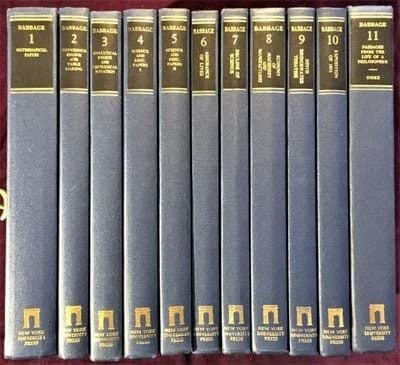
On the Economy of Machinery and ManufacturesBabbage, Charles
ReligionComparative
On the Economy of Machinery and Manufactures
Babbage, Charles
Machinery; Manufactures
123. Swaging. This is an art of copying practised by the
smith. In order to fashion his iron and steel into the various
forms demanded by his customers, he has small blocks of steel
into which are sunk cavities of different shapes; these are
called swages, and are generally in pairs. Thus if he wants a
round bolt, terminating in a cylindrical head of larger diameter,
and having one or more projecting rims, he uses a corresponding
swaging tool; and having heated the end of his iron rod, and
thickened it by striking the end in the direction of the axis
(which is technically called upsetting), he places its head upon
one part of the lage; and whilst an assistant holds the other
part on the top of the hot iron, he strikes it several times with
his hammer, occasionally turning the head one quarter round. The
heated iron is thus forced by the blows to assume the form of the
mould into which it is impressed.
124. Engraving by pressure. This is one of the most beautiful
examples of the art of copying carried to an almost unlimited
extent; and the delicacy with which it can be executed, and the
precision with which the finest traces of the graving tool can be
transferred from steel to copper, or even from hard steel to soft
steel, is most unexpected. We are indebted to Mr Perkins for most
of the contrivances which have brought this art at once almost to
perfection. An engraving is first made upon soft steel, which is
hardened by a peculiar process without in the least injuring its
delicacy. A cylinder of soft steel, pressed with great force
against the hardened steel engraving, is now made to roll very
slowly backward and forward over it, thus receiving the design,
but in relief. The cylinder is in its turn hardened without
injury., and if it be slowly rolled to and fro with strong
pressure on successive plates of copper, it will imprint on a
thousand of them a perfect facsimile of the original steel
engraving from which it was made. Thus the number of copies
producible from the same design may be multiplied a
thousand-fold. But even this is very far short of the limits to
which the process may be extended. The hardened steel roller,
bearing the design upon it in relief may be employed to make a
few of its first impressions upon plates of soft steel, and these
being hardened become the representatives of the original
engraving, and may in their turn be made the parents of other
rollers, each generating copperplates like their prototype. The
possible extent to which facsimiles of one original engraving may
thus be multiplied, almost confounds the imagination, and appears
to be for all practical purposes unlimited.
Public-domain text, read in full here on John Shaqi.
Reviews
Reviews
No reviews yet
Be the first to share your thoughts on this work.
Elsewhere in the archive
Join the Discussion
Join the discussion
Sign in to leave a comment or review.
Sign InorCreate an account