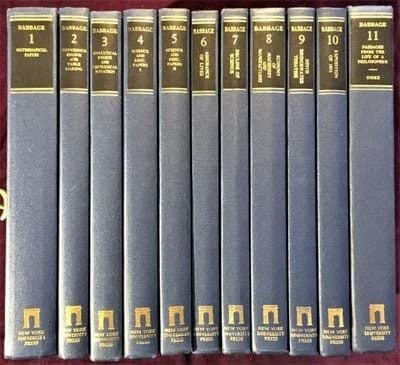
On the Economy of Machinery and ManufacturesBabbage, Charles
ReligionComparative
On the Economy of Machinery and Manufactures
Babbage, Charles
Machinery; Manufactures
This beautiful art was first proposed by Mr Perkins for the
purpose of rendering the forgery of bank notes a matter of great
difficulty; and there are two principles which peculiarly adapt
it to that object: first, the perfect identity of all the
impressions, so that any variation in the minutest line would at
once cause detection; secondly, that the original plates may be
formed by the united labours of several artists most eminent in
their respective departments; for as only one original of each
design is necessary, the expense, even of the most elaborate
engraving, will be trifling, compared with the multitude of
copies produced from it.
125. It must, however, be admitted that the principle of
copying itself furnishes an expedient for imitating any engraving
or printed pattern, however complicated; and thus presents a
difficulty which none of the schemes devised for the prevention
of forgery appear to have yet effectually obviated. In attempting
to imitate the most perfect banknote, the first process would be
to place it with the printed side downwards upon a stone or other
substance, on which, by passing it through a rolling-press, it
might be firmly fixed. The next object would be to discover some
solvent which should dissolve the paper, but neither affect the
printing-ink, nor injure the stone or substance to which it is
attached. Water does not seem to do this effectually, and perhaps
weak alkaline or acid solutions would be tried. If, however, this
could be fully accomplished, and if the stone or other substance,
used to retain the impression, had those properties which enable
us to print from it, innumerable facsimiles of the note might
obviously be made, and the imitation would be complete. Porcelain
biscuit, which has recently been used with a black lead pencil
for memorandum books, seems in some measure adapted for such
trials, since its porosity may be diminished to any required
extent by regulating the dilution of the glazing.
126. Gold and silver moulding. Many of the mouldings used by
jewellers consist of thin slips of metal, which have received
their form by passing between steel rollers, on which the pattern
is embossed or engraved; thus taking a succession of copies of
the devices intended.
127. Ornamental papers. Sheets of paper coloured or covered
with gold or silver leaf, and embossed with various patterns, are
used for covering books, and for many ornamental purposes. The
figures upon these are produced by the same process, that of
passing the sheets of paper between engraved rollers.
Of copying by stamping
128. This mode of copying is extensively employed in the
arts. It is generally executed by means of large presses worked
with a screw and heavy flywheel. The materials on which the
copies are impressed are most frequently metals, and the process
is sometimes executed when they are hot, and in one case when the
metal is in a state between solidity and fluidity.
Public-domain text, read in full here on John Shaqi.
Reviews
Reviews
No reviews yet
Be the first to share your thoughts on this work.
Elsewhere in the archive
Join the Discussion
Join the discussion
Sign in to leave a comment or review.
Sign InorCreate an account