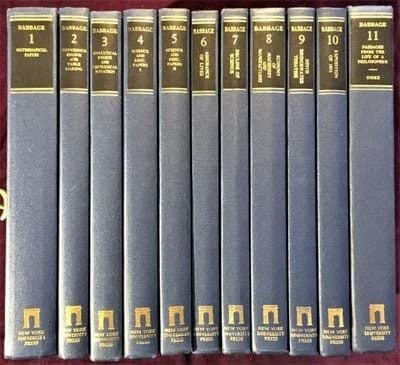
On the Economy of Machinery and ManufacturesBabbage, Charles
ReligionComparative
On the Economy of Machinery and Manufactures
Babbage, Charles
Machinery; Manufactures
1. There exists, perhaps, no single circumstance which
distinguishes our country more remarkably from all others, than
the vast extent and perfection to which we have carried the
contrivance of tools and machines for forming those conveniences
of which so large a quantity is consumed by almost every class of
the community. The amount of patient thought, of repeated
experiment, of happy exertion of genius, by which our
manufactures have been created and carried to their present
excellence, is scarcely to be imagined. If we look around the
rooms we inhabit, or through those storehouses of every
convenience, of every luxury that man can desire, which deck the
crowded streets of our larger cities, we shall find in the
history of each article, of every fabric, a series of failures
which have gradually led the way to excellence; and we shall
notice, in the art of making even the most insignificant of them,
processes calculated to excite our admiration by their
simplicity, or to rivet our attention by their unlooked-for
results.
2. The accumulation of skill and science which has been
directed to diminish the difficulty of producing manufactured
goods, has not been beneficial to that country alone in which it
is concentrated; distant kingdoms have participated in its
advantages. The luxurious natives of the East,(1*) and the ruder
inhabitants of the African desert are alike indebted to our
looms. The produce of our factories has preceded even our most
enterprising travellers.(2*) The cotton of India is conveyed by
British ships round half our planet, to be woven by British skill
in the factories of Lancashire: it is again set in motion by
British capital; and, transported to the very plains whereon it
grew, is repurchased by the lords of the soil which gave it
birth, at a cheaper price than that at which their coarser
machinery enables them to manufacture it themselves.(3*)
3. The large proportion of the population of this country,
who are engaged in manufactures, appears from the following table
deduced from a statement in an Essay on the Distribution of
Wealth, by the Rev. R. Jones:
For every hundred persons employed in agriculture, there are:
Agriculturists Non-agriculturists
In Bengal 100 25
In Italy 100 31
In France 100 50
In England 100 200
The fact that the proportion of non-agricultural to
agricultural persons is continually increasing, appears both from
the Report of the Committee of the House of Commons upon
Manufacturers' Employment, July, 1830, and from the still later
evidence of the last census; from which document the annexed
table of the increase of population in our great manufacturing
towns, has been deduced.
Increase of population per cent
Public-domain text, read in full here on John Shaqi.
Reviews
Reviews
No reviews yet
Be the first to share your thoughts on this work.
Join the Discussion
Join the discussion
Sign in to leave a comment or review.
Sign InorCreate an account