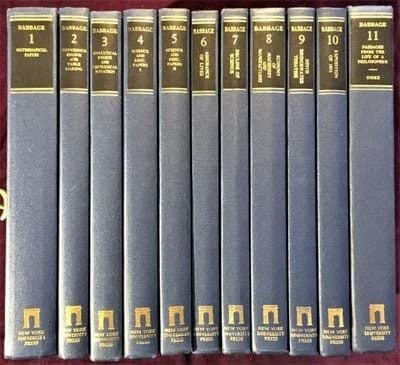
On the Economy of Machinery and ManufacturesBabbage, Charles
ReligionComparative
On the Economy of Machinery and Manufactures
Babbage, Charles
Machinery; Manufactures
166. In the earlier stages of societies the interchange of
the few commodities required was conducted by barter, but as soon
as their wants became more varied and extensive, the necessity of
having some common measure of the value of all commodities--
itself capable of subdivision--became apparent: thus money was
introduced. In some countries shells have been employed for this
purpose; but civilized nations have, by common consent, adopted
the precious metals.(1*) The sovereign power has, in most
countries, assumed the right of coining; or, in other words, the
right of stamping with distinguishing marks, pieces of metal
having certain forms and weights and a certain degree of
fineness: the marks becoming a guarantee, to the people amongst
whom the money circulates, that each piece is of the required
weight and quality.
The expense of manufacturing gold into coin, and that of the
loss arising from wear, as well as of interest on the capital
invested in it, must either be defrayed by the State, or be
compensated by a small reduction in its weight, and is a far less
cost to the nation than the loss of time and inconvenience which
would arise from a system of exchange or barter.
167. These coins are liable to two inconveniences: they may
be manufactured privately by individuals, of the same quality,
and similarly stamped; or imitations may be made of inferior
metal, or of diminished weight. The first of these inconveniences
would be easily remedied by making the current value of the coin
nearly equal to that of the same weight of the metal; and the
second would be obviated by the caution of individuals in
examining the external characters of each coin, and partly by the
punishment inflicted by the State on the perpetrators of such
frauds.
168. The subdivisions of money vary in different countries,
and much time may be lost by an inconvenient system of division.
The effect is felt in keeping extensive accounts, and
particularly in calculating the interest on loans, or the
discount upon bills of exchange. The decimal system is the best
adapted to facilitate all such calculations; and it becomes an
interesting question to consider whether our own currency might
not be converted into one decimally divided. The great step, that
of abolishing the guinea, has already been taken without any
inconvenience, and but little is now required to render the
change complete.
Public-domain text, read in full here on John Shaqi.
Reviews
Reviews
No reviews yet
Be the first to share your thoughts on this work.
Elsewhere in the archive
Join the Discussion
Join the discussion
Sign in to leave a comment or review.
Sign InorCreate an account