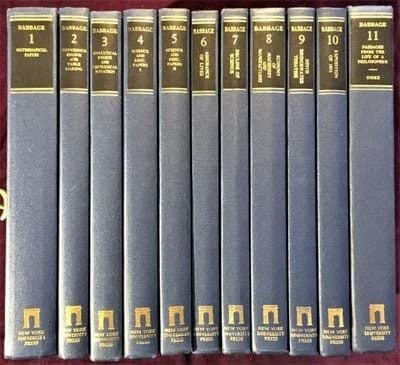
On the Economy of Machinery and ManufacturesBabbage, Charles
ReligionComparative
On the Economy of Machinery and Manufactures
Babbage, Charles
Machinery; Manufactures
169. If, whenever it becomes necessary to call in the
half-crowns, a new coin of the value of two shillings were
issued, which should be called by some name implying a unit (a
prince, for instance), we should have the tenth part of a
sovereign. A few years after, when the public were familiar with
this coin, it might be divided into one hundred instead of
ninety-six farthings; and it would then consist of twenty-five
pence, each of which would be four per cent. less in value than
the former penny. The shillings and six-pences being then
withdrawn from circulation, their place might be supplied with
silver coins each worth five of the new pence, and by others of
ten-pence, and of twopence halfpenny; the latter coin, having a
distinct name, would be the tenth part of a prince.
170. The various manufactured commodities, and the various
property possessed by the inhabitants of a country, all become
measured by the standard thus introduced. But it must be observed
that the value of gold is itself variable; and that, like all
other commodities, its price depends on the extent of the demand
compared with that of the supply.
171. As transactions multiply, and the sums to be paid become
large, the actual transfer of the precious metals from one
individual to another is attended with inconvenience and
difficulty, and it is found more convenient to substitute written
promises to pay on demand specified quantities of gold. These
promises are called bank-notes; and when the person or body
issuing them is known to be able to fulfil the pledge, the note
will circulate for a long time before it gets into the hands of
any person who may wish to make use of the gold it represents.
These paper representatives supply the place of a certain
quantity of gold; and, being much cheaper, a large portion of the
expense of a metallic circulation is saved by their employment.
172. As commercial transactions increase, the transfer of
bank-notes is, to a considerable extent, superseded by shorter
processes. Banks are established, into which all monies are paid,
and out of which all payments are made, through written orders
called checks, drawn by those who keep accounts with them. In a
large capital, each bank receives, through its numerous
customers, checks payable by every other; and if clerks were sent
round to receive the amount in banknotes due from each, it would
occupy much time, and be attended with some risk and
inconvenience.
Public-domain text, read in full here on John Shaqi.
Reviews
Reviews
No reviews yet
Be the first to share your thoughts on this work.
Elsewhere in the archive
Join the Discussion
Join the discussion
Sign in to leave a comment or review.
Sign InorCreate an account