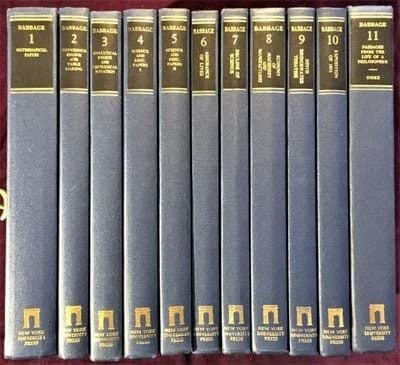
On the Economy of Machinery and ManufacturesBabbage, Charles
ReligionComparative
On the Economy of Machinery and Manufactures
Babbage, Charles
Machinery; Manufactures
177. Every person in a civilized country requires, according
to his station in life, the use of a certain quantity of money,
to make the ordinary purchases of the articles which he consumes.
The same individual pieces of coin, it is true, circulate again
and again, in the same district: the identical piece of silver,
received by the workman on Saturday night, passing through the
hands of the butcher, the baker, and the small tradesman, is,
perhaps, given by the latter to the manufacturer in exchange for
his check, and is again paid into the hands of the workman at the
end of the succeeding week. Any deficiency in this supply of
money is attended with considerable inconvenience to all parties.
If it be only in the smaller coins, the first effect is a
difficulty in procuring small change; then a disposition in the
shopkeepers to refuse change unless a purchase to a certain
amount be made; and, finally, a premium in money will be given
for changing the larger denominations of coin.
Thus money itself varies in price, when measured by other
money in larger masses: and this effect takes place whether the
circulating medium is metallic or of paper. These effects have
constantly occurred, and particularly during the late war; and,
in order to relieve it, silver tokens for various sums were
issued by the Bank of England.
The inconvenience and loss arising from a deficiency of small
money fall with greatest weight on the classes whose means are
least; for the wealthier buyers can readily procure credit for
their small purchases, until their bill amounts to one of the
larger coins.
178. As money, when kept in a drawer, produces nothing, few
people, in any situation of life, will keep, either in coin or in
notes, more than is immediately necessary for their use; when,
therefore, there are no profitable modes of employing money, a
superabundance of paper will return to the source from whence it
issued, and an excess of coin will be converted into bullion and
exported.
179. Since the worth of all property is measured by money, it
is obviously conducive to the general welfare of the community,
that fluctuations in its value should be rendered as small and as
gradual as possible.
Public-domain text, read in full here on John Shaqi.
Reviews
Reviews
No reviews yet
Be the first to share your thoughts on this work.
Elsewhere in the archive
Join the Discussion
Join the discussion
Sign in to leave a comment or review.
Sign InorCreate an account