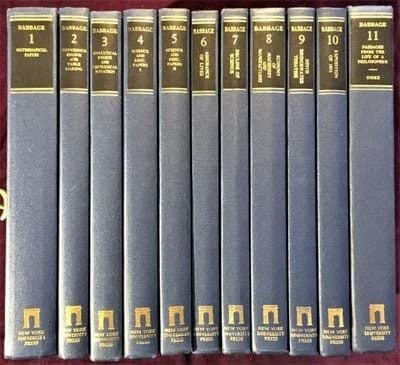
On the Economy of Machinery and ManufacturesBabbage, Charles
ReligionComparative
On the Economy of Machinery and Manufactures
Babbage, Charles
Machinery; Manufactures
The evils which result from sudden changes in the value of
money will perhaps become more sensible, if we trace their
effects in particular instances. Assuming, as we are quite at
liberty to do, an extreme case, let us suppose three persons,
each possessing a hundred pounds: one of these, a widow advanced
in years, and who, by the advice of her friends, purchases with
that sum an annuity of twenty pounds a year during her life: and
let the two others be workmen, who, by industry and economy, have
each saved a hundred pounds out of their wages; both these latter
persons proposing to procure machines for calendering, and to
commence that business. One of these invests his money in a
savings' bank; intending to make his own calendering machine, and
calculating that he shall expend twenty pounds in materials, and
the remaining eighty in supporting himself and in paying the
workmen who assist him in constructing it. The other workman,
meeting with a machine which he can buy for two hundred pounds,
agrees to pay for it a hundred pounds immediately, and the
remainder at the end of a twelvemonth. Let us now imagine some
alteration to take place in the currency, by which it is
depreciated one-half: prices soon adjust themselves to the new
circumstances, and the annuity of the widow, though nominally of
the same amount, will, in reality, purchase only half the
quantity of the necessaries of life which it did before. The
workman who had placed his money in the savings' bank, having
perhaps purchased ten pounds' worth of materials, and expended
ten pounds in labour applied to them, now finds himself, by this
alteration in the currency, possessed nominally of eighty pounds,
but in reality of a sum which will purchase only half the labour
and materials required to finish his machine; and he can neither
complete it, from want of capital, nor dispose of what he has
already done in its unfinished state for the price it has cost
him. In the meantime, the other workman, who had incurred a debt
of a hundred pounds in order to complete the purchase of his
calendering machine, finds that the payments he receives for
calendering, have, like all other prices, doubled, in consequence
of the depreciation of the currency; and he has therefore, in
fact, obtained his machine for one hundred and fifty pounds.
Thus, without any fault or imprudence, and owing to circumstances
over which they have no control, the widow is reduced almost to
starve; one workman is obliged to renounce, for several years,
his hope of becoming a master; and another, without any superior
industry or skill, but in fact, from having made, with reference
to his circumstances, rather an imprudent bargain, finds himself
unexpectedly relieved from half his debt, and the possessor of a
valuable source of profit; whilst the former owner of the
machine, if he also has invested the money arising from its sale
in the savings' bank, finds his property suddenly reduced
one-half.
Public-domain text, read in full here on John Shaqi.
Reviews
Reviews
No reviews yet
Be the first to share your thoughts on this work.
Elsewhere in the archive
Join the Discussion
Join the discussion
Sign in to leave a comment or review.
Sign InorCreate an account