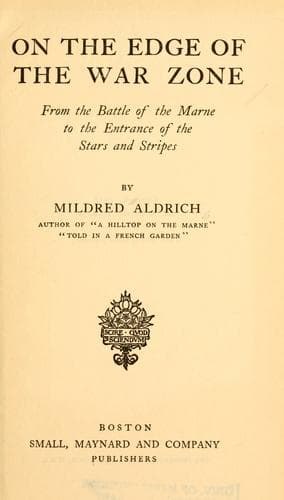
On the Edge of the War Zone: From the Battle of the Marne to the Entrance of the Stars and Stripes — John Shaqi
On the Edge of the War Zone: From the Battle of the Marne to the Entrance of the Stars and StripesAldrich, Mildred
History
On the Edge of the War Zone: From the Battle of the Marne to the Entrance of the Stars and Stripes
Aldrich, Mildred
World War, 1914-1918 -- Personal narratives
It seems that more people stayed at Meaux than I supposed.
Monsignor Morbeau stayed there, and they say about a thousand of
the poor were hidden carefully in the cellars. It had fourteen thousand
inhabitants. Only about five buildings were reached by bombs, and
the damage is not even worth recording.
I am sure you must have seen the Bishop in the days when you lived
in Paris, when he was curé at St. Honoré d'Eylau in the Place Victor
Hugo. At that time he was a popular priest--mondain, clever and
eloquent. At Meaux he is a power. No figure is so familiar in the
picturesque old streets, especially on market day, Saturday, as this
tall, powerful-looking man in his soutane and barrette, with his air of
authority, familiar yet dignified. He seems to know everyone by name,
is all over the market, his keen eyes seeing everything, as influential
in the everyday life of his diocese as he is in its spiritual affairs, a
model of what a modern archbishop ought to be.
I hear he was on the battlefield from the beginning, and that the first
ambulances to reach Meaux found the seminary full of wounded
picked up under his direction and cared for as well as his resources
permitted. He has written his name in the history of the old town
under that of Bossuet--and in the records of such a town that is no
small distinction.
The news which is slowly filtering back to us from the plains is another
matter.
Some of the families in our commune have relatives residing in the
little hamlets between Cregy and Monthyon, and have been out to
help them re-install themselves. Very little in the way of details of the
battle seems to be known. Trees and houses dumbly tell their own
tales. The roads are terribly cut up, but road builders are already at
work. Huge trees have been broken off like twigs, but even there men
are at work, uprooting them and cutting the wood into lengths and
piling it neatly along the roadside to be carted away. The dead are
buried, and Paris automobiles are rapidly removing all traces of the
battles and carrying out of sight such disfigurements as can be
removed.
But the details we get regarding the brief German occupation are too
disgusting for words. It is not the actual destruction of the battle--for
Barcy alone of the towns in sight from here seems to be practically
destroyed--which is the most painful, it is the devastation of the
German occupation, with its deliberate and filthy defilement of the
houses, which defies words, and will leave a blot for all time on the
records of the race so vile-minded as to have achieved it. The
deliberate ingenuity of the nastiness is its most debasing feature. At
Penchard, where the Germans only stayed twenty-four hours, many
people were obliged to make bonfires of the bedding and all sorts of
other things as the only and quickest way to purge the town of danger
in such hot weather.
Public-domain text, read in full here on John Shaqi.
Reviews
Reviews
No reviews yet
Be the first to share your thoughts on this work.
Join the Discussion
Join the discussion
Sign in to leave a comment or review.
Sign InorCreate an account