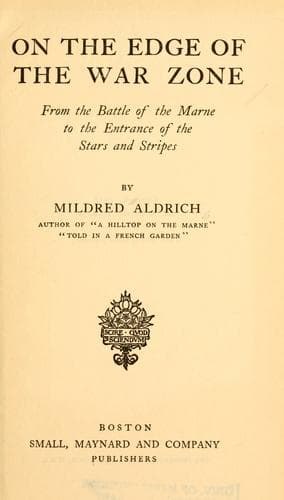
On the Edge of the War Zone: From the Battle of the Marne to the Entrance of the Stars and StripesAldrich, Mildred
History
On the Edge of the War Zone: From the Battle of the Marne to the Entrance of the Stars and Stripes
Aldrich, Mildred
World War, 1914-1918 -- Personal narratives
I do wish, for many reasons, that you could have heard the recitation
by Brochard of Jean Bastia's "L'Autre Cortege," in which the poet
foresees the day "When Joffre shall return down the Champs
Elysées" to the frenzied cries of the populace saluting its victorious
army, and greeting with wild applause "Pétain, who kept Verdun
inviolated," "De Castelnau, who three times in the fray saw a son fall
at his side," "Gouraud, the Fearless," "Marchand, who rushed on the
Boches brandishing his cane," "Mangin, who retook Douaumont,"
and "All those brave young officers, modest even in glory, whose
deeds the world knows without knowing their names," and the soldier
heroes who held the frontier "like a wall of steel from Flanders to
Alsace,"--the heroes of Souchez, of Dixmude, of the Maison du
Passeur, of Souain, of Notre Dame de Lorette, and of the great
retreat. It made a long list and I could feel the thrill running all over
the room full of soldiers who, if they live, will be a part of that
triumphal procession, of which no one talks yet except a poet.
But when he had pictured that scene the tempo of the verse
changed: the music began softly to play a Schumann Reverie to the
lines beginning: "But this triumphal cortège is not enough. The return
of the army demands another cortège,"--the triumph of the Mutilés--
the martyrs of the war who have given more than life to the defence
of France--the most glorious heroes of the war.
The picture the poet made of this "other cortège" moved the soldiers
strangely. The music, which blended wonderfully with Brochard's
beautiful voice, was hardly more than a breath, just audible, but
always there, and added greatly to the effect of the recitation. There
was a sigh in the silence which followed the last line--and an almost
whispered "bravo," before the long shouts of applause broke out.
It is the only number on any programme that has ever touched, even
remotely, on war. It came as a surprise--it had not been announced.
But the intense, rather painful, feeling which had swept over the
audience was instantly removed by a comic monologue, and I need
not tell you that these monologues,--intended to amuse the men from
the trenches and give them a hearty laugh,--are usually very La
Scala--that is to say--rosse. But I do love to hear the boys shout with
glee over them.
The scene in the narrow streets of Quincy after the show is very
picturesque. The road mounts a little to Moulignon, and to see the
blue-grey backs of the boys, quite filling the street between the grey
walls of the houses, as they go slowly back to their cantonnements,
makes a very pretty picture.
Public-domain text, read in full here on John Shaqi.
Reviews
Reviews
No reviews yet
Be the first to share your thoughts on this work.
Elsewhere in the archive
Join the Discussion
Join the discussion
Sign in to leave a comment or review.
Sign InorCreate an account