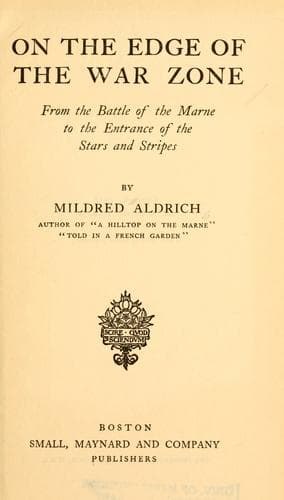
On the Edge of the War Zone: From the Battle of the Marne to the Entrance of the Stars and StripesAldrich, Mildred
History
On the Edge of the War Zone: From the Battle of the Marne to the Entrance of the Stars and Stripes
Aldrich, Mildred
World War, 1914-1918 -- Personal narratives
It did not take me half an hour to get my effects in order, but poor
Amélie's disgust seems to increase with time. You can't deny that if I
had been drummed out and came back to find my house a ruin, my
books and pictures destroyed, and only those worthless bits of china
and plated ware to "start housekeeping again," it would have been
humorous. Real humor is only exaggeration. That would surely have
been a colossal exaggeration.
It is not the first time I have had to ask myself, seriously, "Why this
mania for possession?" The ferryman on the Styx is as likely to take it
across as our railroad is to "handle" it today. Yet nothing seems able
to break a person born with that mania for collecting.
I stood looking round at it all when everything was in place, and I
realized that if the disaster had come, I should have found it easy to
reconcile myself to it in an epoch where millions were facing it with
me. It is the law of Nature. Material things, like the friends we have
lost, may be eternally regretted. They cannot be eternally grieved for.
We must "--be up and doing, With a heart for any fate."
All the same, it was a queer twist in the order of my life, that, hunting
in all directions for a quiet retreat in which to rest my weary spirit, I
should have ended by deliberately sitting myself down on the edge of
a battlefield,--even though it was on the safe edge,--and stranger still,
that there I forgot that my spirit was weary.
We are beginning to pick up all sorts of odd little tales of the
adventures of some of the people who had remained at Voisin. One
old man there, a mason, who had worked on my house, had a very
queer experience. Like all the rest of them, he went on working in the
fields all through the menacing days. I can't make out whether he had
no realization of actual danger, or whether that was his way of
meeting it. Anyway, he disappeared on the morning the battle began,
September 5, and did not return for several days. His old wife had
made up her mind that the Germans had got him, when one morning
he turned up, tired, pale, and hungry, and not in any state to explain
his absence.
It was some days before his wife could get the story out of him. He
owns a field about halfway between Voisins and Mareuil, close to the
route de Pavé du Roi, and on the morning that the battle began he
was digging potatoes there. Suddenly he saw a small group of
horsemen riding down from the canal, and by their spiked helmets he
knew them for Germans.
His first idea, naturally, was to escape. He dropped his hoe, but he
was too paralyzed with fear to run, and there was nothing to hide
behind. So he began walking across the field as well as his trembling
old legs would let him, with his hands in his pockets.
Of course the Uhlans overtook him in a few minutes, and called out to
him, in French, to stop. He stopped at once, expecting to be shot
instantly.
Public-domain text, read in full here on John Shaqi.
Reviews
Reviews
No reviews yet
Be the first to share your thoughts on this work.
Join the Discussion
Join the discussion
Sign in to leave a comment or review.
Sign InorCreate an account