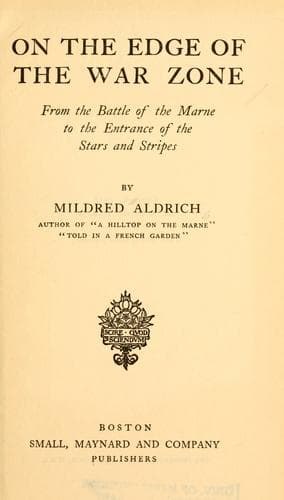
On the Edge of the War Zone: From the Battle of the Marne to the Entrance of the Stars and StripesAldrich, Mildred
History
On the Edge of the War Zone: From the Battle of the Marne to the Entrance of the Stars and Stripes
Aldrich, Mildred
World War, 1914-1918 -- Personal narratives
The fall of Antwerp was accepted as inevitable, but it gave us all a
sad day. It was no use to write you things of that sort. You, I presume,
do not need to be told, although you are so far away, that for me,
personally, it could only increase the grief I felt that Washington had
not made the protest I expected when the Belgian frontier was
crossed. It would have been only a moral effort, but it would have
been a blow between the eyes for the nervous Germans.
All the words we get from the front tell us that the boys are standing
the winter in the trenches very well. They've simply got to--that is all
there is to that.
Amélie is more astonished than I am. When she first realized that
they had got to stay out there in the rain and the mud and the cold,
she just gasped out that they never would stand it.
I asked her what they would do then--lie down and let the Germans
ride over them? Her only reply was that they would all die. It is hard
for her to realize yet the resistance of her own race.
I am realizing in several ways, in a small sense, what the men are
enduring. I take my bit of daily exercise walking round my garden. I
always have to carry a trowel in my sweater pocket, and I stop every
ten steps to dig the cakes of mud off my sabots. I take up a good bit
of my landed property at every step. So I can guess, at least, what it
must be out in the trenches. This highly cultivated, well-fertilized
French soil has its inconveniences in a country where the ground
rarely freezes as it does in New England.
Also I am very cold.
When I came out here I found that the coal dealer was willing to
deliver coal to me once a week. I had a long, covered box along the
wall of the kitchen which held an ample supply of coal for the week.
The system had two advantages--it enabled me to do my trading in
the commune, which I liked, and it relieved Amélie from having to
carry heavy hods of coal in all weathers from the grange outside. But,
alas, the railroad communications being cut--no coal! I had big wood
enough to take me through the first weeks, and have some still, but it
will hardly last me to Christmas--nor does the open fire heat the
house as the salamandre did. But it is wartime, and I must not
complain--yet.
Public-domain text, read in full here on John Shaqi.
Reviews
Reviews
No reviews yet
Be the first to share your thoughts on this work.
Join the Discussion
Join the discussion
Sign in to leave a comment or review.
Sign InorCreate an account