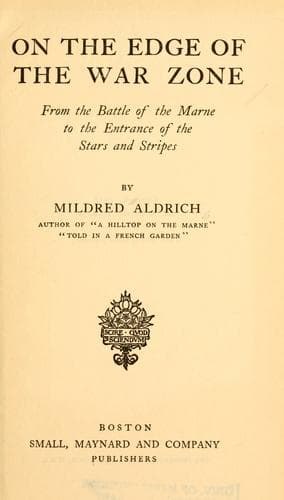
On the Edge of the War Zone: From the Battle of the Marne to the Entrance of the Stars and Stripes — John Shaqi
On the Edge of the War Zone: From the Battle of the Marne to the Entrance of the Stars and StripesAldrich, Mildred
History
On the Edge of the War Zone: From the Battle of the Marne to the Entrance of the Stars and Stripes
Aldrich, Mildred
World War, 1914-1918 -- Personal narratives
It was not until we were entering into Chauconin that we saw the first
signs of war. The approach through the fields, already ploughed, and
planted with winter grain, looked the very last thing to be associated
with war. Once inside the little village--we always speak of it as "le
petit Chauconin "--we found destruction enough. One whole street of
houses was literally gutted. The walls stand, but the roofs are off and
doors and windows gone, while the shells seem burned out. The
destruction of the big farms seems to have been pretty complete.
There they stood, long walls of rubble and plaster, breeched; ends of
farm buildings gone; and many only a heap of rubbish. The surprising
thing to me was to see here a house destroyed, and, almost beside it,
one not even touched. That seemed to prove that the struggle here
was not a long one, and that a comparatively small number of shells
had reached it.
Neufmortier was in about the same condition. It was a sad sight, but
not at all ugly. Ruins seem to "go" with the French atmosphere and
background. It all looked quite natural, and I had to make an effort to
shake myself into a becoming frame of mind. If you had been with me
I should have asked you to pinch me, and remind me that "all this is
not yet ancient history," and that a little sentimentality would have
become me. But Amélie would never have understood me.
It was not until we were driving east again to approach Penchard that
a full realization of it came to me. Penchard crowns the hill just in the
centre of the line which I see from the garden. It was one of the towns
bombarded on the evening of September 5, and, so far as I can
guess, the destruction was done by the French guns which drove the
Germans out that night.
They say the Germans slept there the night of September 4, and
were driven out the next day by the French soixante-quinze, which
trotted through Chauconin into Penchard by the road we had just
come over.
I enclose you a carte postale of a battery passing behind the apse of
the village church, just as a guarantee of good faith.
But all signs of the horrors of those days have been obliterated.
Penchard is the town in which the Germans exercised their taste for
wilful nastiness, of which I wrote you weeks ago. It is a pretty little
village, beautifully situated, commanding the slopes to the Marne on
one side, and the wide plains of Barcy and Chambry on the other. It is
prosperous looking, the home of sturdy farmers and the small
rentiers. It has an air of humble thrift, with now and then a pretty
garden, and here and there suggestions of a certain degree of
greater prosperity, an air which, in France, often conceals
unexpected wealth.
You need not look the places up unless you have a big map. No
guide-book ever honored them.
From Penchard we ran a little out to the west at the foot of the hill, on
top of which stand the white walls of Montyon, from which, on
September 5, we had seen the first smoke of battle.
Public-domain text, read in full here on John Shaqi.
Reviews
Reviews
No reviews yet
Be the first to share your thoughts on this work.
Join the Discussion
Join the discussion
Sign in to leave a comment or review.
Sign InorCreate an account