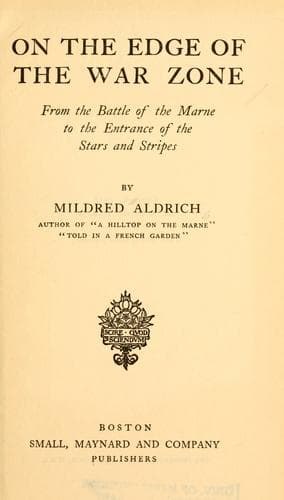
On the Edge of the War Zone: From the Battle of the Marne to the Entrance of the Stars and StripesAldrich, Mildred
History
On the Edge of the War Zone: From the Battle of the Marne to the Entrance of the Stars and Stripes
Aldrich, Mildred
World War, 1914-1918 -- Personal narratives
While I was waiting for the train at Esbly I had a conversation with a
woman who chanced to sit beside me on a bench on the quai, which
seemed to me significant.
Today everyone talks to everyone. All the barriers seem to be down.
We were both reading the morning paper, and so, naturally, got to
talking. I happened to have an English paper, in which there was a
brief account of the wonderful dash made by the Royal Scots at Petit
Bois and the Gordon Highlanders at Maeselsyeed Spur, under cover
of the French and British artillery, early in the month, and I translated
it for her. It is a moral duty to let the French people get a glimpse of
the wonderful fighting quality of the boys under the Union Jack.
In the course of the conversation she said, what was self-evident,
"You are not French?" I told her that I was an American. Then she
asked me if I had any children, and received a negative reply.
She sighed, and volunteered that she was a widow with an only son
who was "out there," and added: "We are all of us French women of
a certain class so stupid when we are young. I adore children. But I
thought I could only afford to have one, as I wanted to do so much for
him. Now if I lose that one, what have I to live for? I am not the sort of
woman who can marry again. My boy is a brave boy. If he dies he will
die like a brave man, and not begrudge the life he gives for his
country. I am a French mother and must offer him as becomes his
mother. But it was silly of me to have but this one. I know, now that it
is too late, that I could have done as well, and it may be better, with
several, for I have seen the possibilities demonstrated among my
friends who have three or four."
Of course I did not say that the more she had, the more she might
have had to lose, because I thought that if, in the face of a disaster
like this, French women were thinking such thoughts--and if one
does, hundreds may--it might be significant.
I had a proof of this while in Paris. I went to a house where I have
been a visitor for years to get some news of a friend who had an
apartment there. I opened the door to the concierge's loge to put my
question. I stopped short. In the window, at the back of the half dark
room, sat the concierge, whom I had known for nearly twenty years, a
brave, intelligent, fragile woman. She was sitting there in her black
frock, gently rocking herself backward and forward in her chair. I did
not need to put a question. One knows in these days what the
unaccustomed black dress means, and I knew that the one son I had
seen grow from childhood, for whom she and the father had
sacrificed everything that he might be educated, for whom they had
pinched and saved--was gone.
I said the few words one can say--I could not have told five minutes
later what they were--and her only reply was like the speech of the
woman of another class that I had met at Esbly.
"I had but the one. That was my folly. Now I have nothing--and I have
a long time to live alone."
Public-domain text, read in full here on John Shaqi.
Reviews
Reviews
No reviews yet
Be the first to share your thoughts on this work.
Join the Discussion
Join the discussion
Sign in to leave a comment or review.
Sign InorCreate an account