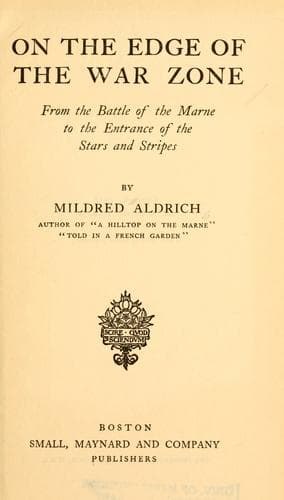
On the Edge of the War Zone: From the Battle of the Marne to the Entrance of the Stars and StripesAldrich, Mildred
History
On the Edge of the War Zone: From the Battle of the Marne to the Entrance of the Stars and Stripes
Aldrich, Mildred
World War, 1914-1918 -- Personal narratives
Didn't you always think a cat hated water? I am sure I did. He goes
out in all weathers. Last winter he played in the snow like a child, and
rolled in it, and no rainstorm can keep him in the house. The other
day he insisted on going out in a pouring rain, and I got anxious about
him. Finally I went to the door and called him, and, after a while, he
walked out of the dog's kennel, gave me a reproachful look as if to
say, "Can't you leave a chap in peace?" and returned to the kennel.
The one thing he really hates is to have me leave the house. He goes
where his sweet will leads him, but he seems to think that I should be
always on the spot.
XXIV
May 23, 1916
I begin to believe that we shall have no normal settled weather until
all this cannon play is over. We've had most unseasonable hailstorms
which have knocked all the buds off the fruit-trees, so, in addition to
other annoyances, we shall have no fruit this year.
There is nothing new here except that General Foch is in the
ambulance at Meaux. No one knows it; not a word has appeared in
the newspapers. It was the result of a stupid, but unavoidable,
automobile accident. To avoid running over a woman and child on a
road near here, the automobile, in which he was travelling rapidly in
company with his son-in-law, ran against a tree and smashed. Luckily
he was not seriously hurt, though his head got damaged.
On Thursday Poincaré passed over our hill, with Briand, en route to
meet Joffre at the General's bedside. I did not see them, but some of
the people at Quincy did. It was a lucky escape for Foch. He would
have hated to die during this war of a simple, unmilitary automobile
accident, and the army could ill afford just now to lose one of the
heroes of the Marne. Carefully as the fact has been concealed, we
knew it here through our ambulance, which is a branch of that at
Meaux, where he is being nursed.
Three months since the battle at Verdun began, and it is still going
on, with the Germans hardly more than four miles from the city, and
yet it begins to look as if they knew themselves that the battle--the
most terrible the world has ever seen--was a failure. Still, I have
changed my mind. I begin to believe that had Germany centred all
her forces on that frontier in August, 1914, when her first-line troops
were available, and their hopes high, she would probably have
passed. No one can know that, but it is likely, and many military men
think so. Isn't it a sort of poetic justice to think that it is even
possible that had Germany fought an honorable war she might have
got to Paris? "Whom the gods destroy, they first make mad."
Public-domain text, read in full here on John Shaqi.
Reviews
Reviews
No reviews yet
Be the first to share your thoughts on this work.
Elsewhere in the archive
Join the Discussion
Join the discussion
Sign in to leave a comment or review.
Sign InorCreate an account