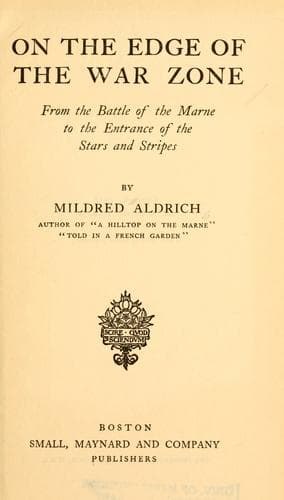
On the Edge of the War Zone: From the Battle of the Marne to the Entrance of the Stars and StripesAldrich, Mildred
History
On the Edge of the War Zone: From the Battle of the Marne to the Entrance of the Stars and Stripes
Aldrich, Mildred
World War, 1914-1918 -- Personal narratives
I do nothing but work in the garden on rare days when it does not
rain, and listen to the cannon. That can't be very interesting stuff to
make a letter of. The silence here, which was so dear to me in the
days when I was preparing the place, still hangs over it. But, oh, the
difference! Now and then, in spite of one's self, the very thought of all
that is going on so very near us refuses to take its place and keep in
the perspective, it simply jumps out of the frame of patriotism and the
welfare of the future. Then the only thing to do is to hunt for the visible
consolations--and one always finds them.
For example--wouldn't it seem logical that such a warfare would
brutalize the men who are actually in it? It doesn't. It seems to have
just the contrary effect. I can't tell you how good the men are to one
another, or how gentle they are to the children. It is strange that it
should be so, but it is. I don't try to understand it, I merely set it down
for you.
XXV
June 16, 1916
You can imagine how trying and unseasonable the weather is when I
tell you that I not only had a fire yesterday, but that I went to bed with
a hotwater bottle. Imagine it! I have only been able to eat out-of-doors
once so far.
This is not a letter--just a line, lest you worry if you do not hear that I
am well. I am too anxiously watching that see-saw at Verdun, with the
German army only four miles from the city, at the end of the fourth
month, to talk about myself, and in no position to write about things
which you know. One gets dumb, though not hopeless. To add to our
anxieties the crops are not going to be good. It was continually wet at
planting time, and so cold, and there has been so little sun that
potatoes are rotting in the fields already, and the harvest will be
meagre. The grain, especially that planted last fall, is fairly good, but,
as I told you, after the tempest we had, there is to be no fruit. When I
say none, I absolutely mean none. I have not one cherry. Louise
counted six prunes on my eight trees, and I have just four pears and
not a single apple. Père's big orchard is in the same condition. In
addition, owing to the terrible dampness,--the ground is wet all the
time,--the slugs eat up all the salad, spoil all the strawberries, and
chew off every young green thing that puts its head above the
ground, and that in spite of very hard work on my part. Every morning
early, and every afternoon, at sundown, I put in an hour's hard work,--
hard, disgusting work,--picking them up with the tongs and dropping
them into boiling water. So you see every kind of war is going on at
the same time. Where is the good of wishing a bad harvest on
Germany, when we get it ourselves at the same time? However, I
suppose that you in the States can help us out, and England has jolly
well fixed it so that no one can easily help Germany out.
XXVI
August 4, 1916
Public-domain text, read in full here on John Shaqi.
Reviews
Reviews
No reviews yet
Be the first to share your thoughts on this work.
Elsewhere in the archive
Join the Discussion
Join the discussion
Sign in to leave a comment or review.
Sign InorCreate an account