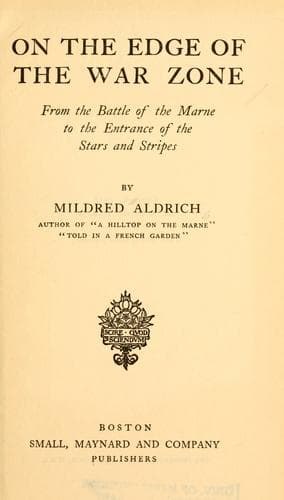
On the Edge of the War Zone: From the Battle of the Marne to the Entrance of the Stars and StripesAldrich, Mildred
History
On the Edge of the War Zone: From the Battle of the Marne to the Entrance of the Stars and Stripes
Aldrich, Mildred
World War, 1914-1918 -- Personal narratives
I have got into a mood where it seems simply stupid to talk about it,
since I am, as usual, only eternally a spectator. I only long to keep my
eyes raised in a wide arc towards the end, to live each day as I can,
and wait. So why should I try to write to you of things which I do not
see, and of which only the last, faint, dying ripples reach us here?
You really must not pity me, as you insist upon doing, because
military restrictions draw a line about me, which I may not cross at my
own sweet will. I am used to it. It is not hard. For that matter, it is
much more trying to my French neighbors than it is to me.
I seem never to have told you that even they may not leave the
commune without a sauf-conduit. To be sure, they have only to go to
the mairie, and ask for it, to get it.
For months now the bridge over the Marne, at Meaux, has been
guarded, and even those going to market cannot cross without
showing their papers. The formality is very trying to them, for the
reason that the mairie opens at eight, and closes at twelve not to
reopen again until three and close at six. You see those hours are
when everyone is busiest in the fields. The man or woman who has to
go to market on Saturday must leave work standing and make a long
trip into Quincy--and often they have three or four miles to go on foot
to do it--just at the hour when it is least easy to spare the time.
To make it harder still, a new order went out a few weeks ago. Every
man, woman, and child (over fifteen) in the war zone has to have,
after October 1, a carte d'identité, to which must be affixed a
photograph.
This regulation has resulted in the queerest of embarrassments. A
great number of these old peasants--and young ones too--never had
a photograph taken. There is no photographer. The photographer at
Esbly and the two at Meaux could not possibly get the people all
photographed, and, in this uncertain weather, the prints made, in the
delay allowed by the military authorities. A great cry of protestation
went up. Photographers of all sorts were sent into the commune. The
town crier beat his drum like mad, and announced the places where
the photographers would be on certain days and hours, and ordered
the people to assemble and be snapped.
One of the places chosen was the courtyard at Amélie's, and you
would have loved seeing these bronzed old peasants facing a
camera for the first time. Some of the results were funny, especially
when the hurried and overworked operator got two faces on the
same negative, as happened several times.
Public-domain text, read in full here on John Shaqi.
Reviews
Reviews
No reviews yet
Be the first to share your thoughts on this work.
Elsewhere in the archive
Join the Discussion
Join the discussion
Sign in to leave a comment or review.
Sign InorCreate an account