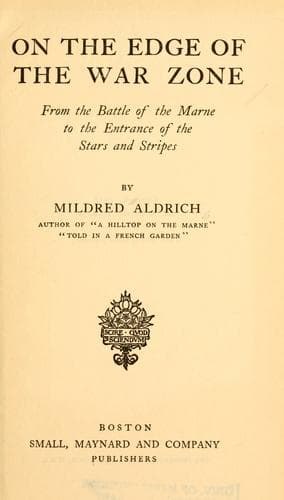
On the Edge of the War Zone: From the Battle of the Marne to the Entrance of the Stars and StripesAldrich, Mildred
History
On the Edge of the War Zone: From the Battle of the Marne to the Entrance of the Stars and Stripes
Aldrich, Mildred
World War, 1914-1918 -- Personal narratives
Real autumn weather is here, but, for that matter, it has been more
like autumn than summer since last spring. The fields are lovely to
see on days when the sun shines. I drove the other day just for the
pleasure of sitting in my perambulator, on the hillside, and looking
over the slope of the wide wheat fields, where the women, in their
cotton jackets and their wide hats, were reaping. The harvesting
never looked so picturesque. I could pick out, in the distance, the tall
figure of my Louise, with a sheaf on her head and a sickle in her
hand, striding across the fields, and I thought how a painter would
have loved the scene, with the long rays of the late September
sunset illuminating the yellow stretch.
Last Wednesday we had a little excitement here, because sixteen
German prisoners, who were working on a farm at Vareddes,
escaped--some of them disguised as women.
I wasn't a bit alarmed, as it hardly seemed possible that they would
venture near houses in this district, but Père was very nervous, and
every time the dog barked he was out in the road to make sure that I
was all right.
Oddly enough, it happened on the very day when two hundred
arrived at Meaux to work in the sugar refinery. The next day there
was a regular battue, as the gendarmes beat up the fields and woods
in search of the fugitives.
If they caught them, they don't tell, but we have been ordered to
harbor no strangers under a severe penalty. But that condition has
really existed since the war broke out, as no one is even allowed to
engage a workman whose papers have not been visé at the mairie.
I have had to have a wood fire today--it is alarming, with winter
ahead, and so little fuel, to have to begin heating up at the end of
September--three weeks or a month earlier than usual.
XXVIII
November 25, 1916
It is raining,--a cold and steady downpour. I don't feel in the least like
writing a letter. This is only to tell you that I have got enough
anthracite coal to go to the end of February, and that the house is
warm and cosy, and I am duly thankful to face this third war-winter
free from fear of freezing. It cost thirty-two dollars a ton. How does
that sound to you?
I have planted my tulip bulbs, cleaned up the garden for winter and
settled down to life inside my walls, with my courage in both hands,
and the hope that next spring's offensive will not be a great
disappointment.
In the meantime I am sorry that Franz Josef did not live to see this
war of his out and take his punishment. I used to be so sorry for him
in the old days, when it seemed as if Fate showered disasters on the
heads of the Hapsburgs. I wasted my pity. The blows killed everyone
in the family but father. The way he stood it and never learned to be
kind or wise proved how little he needed pity.
Public-domain text, read in full here on John Shaqi.
Reviews
Reviews
No reviews yet
Be the first to share your thoughts on this work.
Elsewhere in the archive
Join the Discussion
Join the discussion
Sign in to leave a comment or review.
Sign InorCreate an account