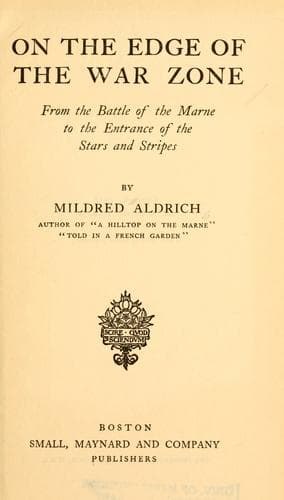
On the Edge of the War Zone: From the Battle of the Marne to the Entrance of the Stars and StripesAldrich, Mildred
History
On the Edge of the War Zone: From the Battle of the Marne to the Entrance of the Stars and Stripes
Aldrich, Mildred
World War, 1914-1918 -- Personal narratives
All the signs say a cold winter. How I envy hibernating animals! I want
to live to see this thing out, but it would be nice to crawl into a hole,
like a bear, and sleep comfortably until the sun came out in the
spring, and the seeds began to sprout, and the army was thawed out,
and could move. In the silence on this hilltop, where nothing happens
but dishwashing and bedmaking and darning stockings, it is a long
way to springtime, even if it comes early.
I amused myself last week by defying the consign. I had not seen a
gendarme on the road for weeks. I had driven to Couilly once or
twice, though to do it I had to cross "the dead line." I had met the
garde champêtre there, and even talked to him, and he had said
nothing. So, hearing one day that my friend from Voulangis had a
permission to drive to the train at Esbly, and that she was returning
about nine in the morning, I determined to meet her on the road, and
at least see how she was looking and have a little chat. I felt a longing
to hear someone say: "Hulloa, you,"--just a few words in English.
So if you could have seen the road, just outside of Couilly, Thursday
morning, just after nine, you would have seen a Southern girl sitting in
a high cart facing east, and an elderly lady in a donkey cart facing
west, and the two of them watching the road ahead for the coming of
a bicycle pedalled by a gendarme with a gun on his back, as they
talked like magpies. It was all so funny that I was convulsed with
laughter. There we were, two innocent, harmless American women,
talking of our family affairs and our gardens, our fuel, our health, and
behaving like a pair of conspirators. We didn't dare to get out to
embrace each other, for fear--in case we saw a challenge coming--
that I could not scramble back and get away quickly enough, and we
only stayed a quarter of an hour. We might just as well have carried
our lunch and spent the day so far as I could see--only if anyone had
passed and had asked for our papers there would have been trouble.
However, we had our laugh, and decided that it was not worth while
to risk it again. But I could not help asking myself how, with all their
red tape, they ever caught any real suspect.
Do you remember that I told you some time ago about Louise's
brother, Joseph, in the heavy artillery, who had never seen a Boche?
Well, he is at home again for his eight days. He came to see me
yesterday. I said to him: "Well, Joseph, where did you come from this
time?"
"From the same place--the mountains in Alsace. We've not budged
for nearly two years."
"How long are you going to stay there?"
"To the end of the war, I imagine."
"But why?" I asked.
"What can we do, madame?" he replied. "There we are, on the top of
a mountain. We can't get down. The Germans can't get up. They are
across the valley on the top of a hill in the same fix."
"But what do you do up there?" I demanded.
Public-domain text, read in full here on John Shaqi.
Reviews
Reviews
No reviews yet
Be the first to share your thoughts on this work.
Elsewhere in the archive
Join the Discussion
Join the discussion
Sign in to leave a comment or review.
Sign InorCreate an account