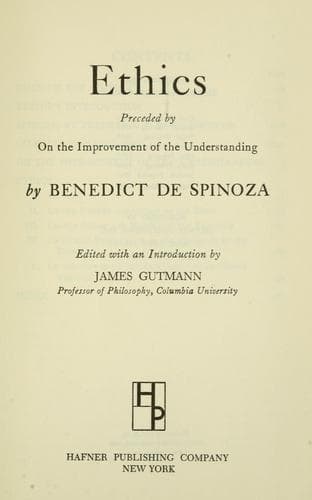
On the Improvement of the Understanding — John Shaqi
On the Improvement of the UnderstandingSpinoza, Benedictus de
PhilosophyPhilosophy
On the Improvement of the Understanding
Spinoza, Benedictus de
Free thought; Philosophy and religion
On the Improvement of the Understanding
(Treatise on the Emendation of the Intellect)
by
Baruch Spinoza
[Benedict de Spinoza]
Translated by R. H. M. Elwes
TABLE OF CONTENTS:
1 On the Improvement of the Understanding
3 Of the ordinary objects of men's desires
12 Of the true and final good
17 Certain rules of life
19 Of the four modes of perception
25 Of the best mode of perception
33 Of the instruments of the intellect, or true ideas
43 Answers to objections
First part of method:
50 Distinction of true ideas from fictitious ideas
64 And from false ideas
77 Of doubt
81 Of memory and forgetfulness
86 Mental hindrances from words--and from the popular confusion
of ready imagination with distinct understanding.
Second part of method:
91 Its object, the acquisition of clear and distinct ideas
94 Its means, good definitions
Conditions of definition
107 How to define understanding
----------------------------------------------------------------------
[Notice to the Reader.]
(This notice to the reader was written by the editors of the
Opera Postuma in 1677. Taken from Curley, Note 3, at end)
*This Treatise on the Emendation of the Intellect etc., which we
give you here, kind reader, in its unfinished [that is, defective]
state, was written by the author many years ago now. He always
intended to finish it. But hindered by other occupations, and
finally snatched away by death, he was unable to bring it to the
desired conclusion. But since it contains many excellent and useful
things, which--we have no doubt--will be of great benefit to
anyone sincerely seeking the truth, we did not wish to deprive you
of them. And so that you would be aware of, and find less difficult
to excuse, the many things that are still obscure, rough, and
unpolished, we wished to warn you of them. Farewell.*
[1] (1) After experience had taught me that all the usual
surroundings of social life are vain and futile; seeing that none
of the objects of my fears contained in themselves anything either
good or bad, except in so far as the mind is affected by them,
I finally resolved to inquire whether there might be some real
good having power to communicate itself, which would affect the
mind singly, to the exclusion of all else: whether, in fact, there
might be anything of which the discovery and attainment would
enable me to enjoy continuous, supreme, and unending happiness.
Public-domain text, read in full here on John Shaqi.
Reviews
Reviews
No reviews yet
Be the first to share your thoughts on this work.
Join the Discussion
Join the discussion
Sign in to leave a comment or review.
Sign InorCreate an account