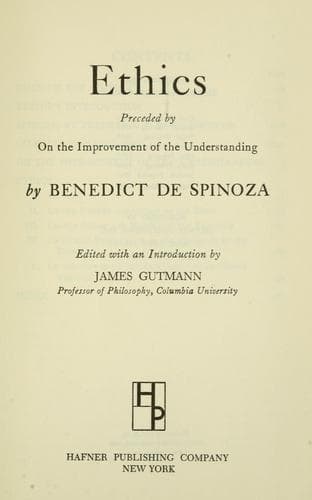
On the Improvement of the UnderstandingSpinoza, Benedictus de
PhilosophyPhilosophy
On the Improvement of the Understanding
Spinoza, Benedictus de
Free thought; Philosophy and religion
[34] (1) For instance, the man Peter is something real; the true
idea of Peter is the reality of Peter represented subjectively,
and is in itself something real, and quite distinct from the
actual Peter. (2) Now, as this true idea of Peter is in itself
something real, and has its own individual existence, it will
also be capable of being understood--that is, of being the
subject of another idea, which will contain by representation
(objective) all that the idea of Peter contains actually
(formaliter). (3) And, again, this idea of the idea of Peter
has its own individuality, which may become the subject of yet
another idea; and so on, indefinitely. (4) This everyone may
make trial of for himself, by reflecting that he knows what
Peter is, and also knows that he knows, and further knows that
he knows that he knows, &c. (34:5) Hence it is plain that, in
order to understand the actual Peter, it is not necessary first
to understand the idea of Peter, and still less the idea of
the idea of Peter. (6) This is the same as saying that, in order
to know, there is no need to know that we know, much less to
know that we know that we know. (7) This is no more necessary
than to know the nature of a circle before knowing the nature of
a triangle. [n]. (8) But, with these ideas, the contrary is the
case: for, in order to know that I know, I must first know.
[35] (1) Hence it is clear that certainty is nothing else than
the subjective essence of a thing: in other words, the mode in
which we perceive an actual reality is certainty. (2) Further,
it is also evident that, for the certitude of truth, no further
sign is necessary beyond the possession of a true idea: for,
as I have shown, it is not necessary to know that we know that
we know. (3) Hence, again, it is clear that no one can know
the nature of the highest certainty, unless he possesses an
adequate idea, or the subjective essence of a thing:
certainty is identical with such subjective essence.
[36] (1) Thus, as the truth needs no sign--it being to possess
the subjective essence of things, or, in other words, the ideas
of them, in order that all doubts may be removed--it follows
that the true method does not consist in seeking for the signs
of truth after the acquisition of the idea, but that the true
method teaches us the order in which we should seek for truth
itself, [o] or the subjective essences of things, or ideas,
for all these expressions are synonymous.
[37] (1) Again, method must necessarily be concerned with
reasoning or understanding--I mean, method is not identical
with reasoning in the search for causes, still less is it
the comprehension of the causes of things: it is the
discernment of a true idea, by distinguishing it from other
perceptions, and by investigating its nature, in order that
we may so train our mind that it may, by a given standard,
comprehend whatsoever is intelligible, by laying down
certain rules as aids, and by avoiding useless mental
exertion.
Public-domain text, read in full here on John Shaqi.
Reviews
Reviews
No reviews yet
Be the first to share your thoughts on this work.
Join the Discussion
Join the discussion
Sign in to leave a comment or review.
Sign InorCreate an account