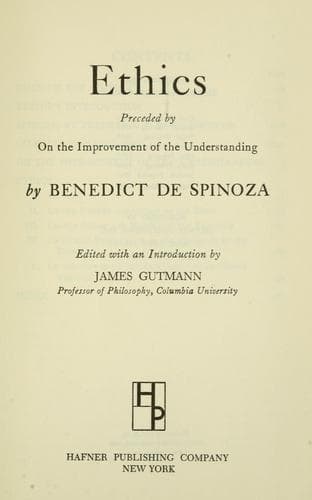
On the Improvement of the Understanding — John Shaqi
On the Improvement of the UnderstandingSpinoza, Benedictus de
PhilosophyPhilosophy
On the Improvement of the Understanding
Spinoza, Benedictus de
Free thought; Philosophy and religion
[41] (1) We may add that the idea in the world of thought is in
the same case as its correlate in the world of reality. (2) If,
therefore, there be anything in nature which is without connection
with any other thing, and if we assign to it a subjective essence,
which would in every way correspond to the objective reality,
the subjective essence would have no connection, [p] with any
other ideas--in other words, we could not draw any conclusions
with regard to it. (41:3) On the other hand, those things which are
connected with others--as all things that exist in nature--will
be understood by the mind, and their subjective essences will
maintain the same mutual relations as their objective realities--that
is to say, we shall infer from these ideas other ideas, which
will in turn be connected with others, and thus our instruments
for proceeding with our investigation will increase. (4) This is
what we were endeavoring to prove.
[42] (1) Further, from what has just been said--namely, that an
idea must, in all respects, correspond to its correlate in the
world of reality,--it is evident that, in order to reproduce in
every respect the faithful image of nature, our mind must deduce
all its ideas from the idea which represents the origin and source
of the whole of nature, so that it may itself become the source
of other ideas.
[43] (1) It may, perhaps, provoke astonishment that, after having
said that the good method is that which teaches us to direct our
mind according to the standard of the given true idea, we should
prove our point by reasoning, which would seem to indicate that it
is not self-evident. (2) We may, therefore, be questioned as to
the validity of our reasoning. (3) If our reasoning be sound, we
must take as a starting-point a true idea. (4) Now, to be certain
that our starting-point is really a true idea, we need proof.
(5) This first course of reasoning must be supported by a second,
the second by a third, and so on to infinity.
[44] (1) To this I make answer that, if by some happy chance anyone
had adopted this method in his investigations of nature--that is,
if he had acquired new ideas in the proper order, according to the
standard of the original true idea, he would never have doubted [q]
of the truth of his knowledge, inasmuch as truth, as we have shown,
makes itself manifest, and all things would flow, as it were,
spontaneously towards him. (44:2) But as this never, or rarely,
happens, I have been forced so to arrange my proceedings, that we
may acquire by reflection and forethought what we cannot acquire
by chance, and that it may at the same time appear that, for
proving the truth, and for valid reasoning, we need no other means
than the truth and valid reasoning themselves: for by valid
reasoning I have established valid reasoning, and, in like measure,
I seek still to establish it.
Public-domain text, read in full here on John Shaqi.
Reviews
Reviews
No reviews yet
Be the first to share your thoughts on this work.
Join the Discussion
Join the discussion
Sign in to leave a comment or review.
Sign InorCreate an account