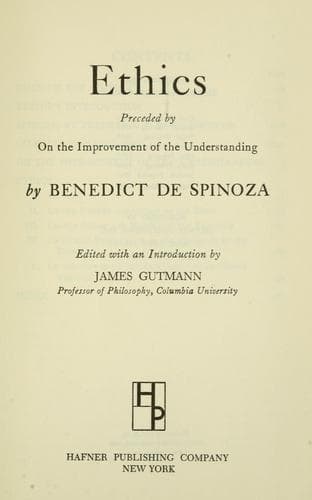
On the Improvement of the UnderstandingSpinoza, Benedictus de
PhilosophyPhilosophy
On the Improvement of the Understanding
Spinoza, Benedictus de
Free thought; Philosophy and religion
[6] (1) When I saw that all these ordinary objects of desire would
be obstacles in the way of a search for something different and new--nay,
that they were so opposed thereto, that either they or it would
have to be abandoned, I was forced to inquire which would prove the
most useful to me: for, as I say, I seemed to be willingly losing
hold on a sure good for the sake of something uncertain. (6:2) However,
after I had reflected on the matter, I came in the first place to the
conclusion that by abandoning the ordinary objects of pursuit, and
betaking myself to a new quest, I should be leaving a good, uncertain
by reason of its own nature, as may be gathered from what has been
said, for the sake of a good not uncertain in its nature (for I sought
for a fixed good), but only in the possibility of its attainment.
[7] (1) Further reflection convinced me that if I could really get
to the root of the matter I should be leaving certain evils for a
certain good. (2) I thus perceived that I was in a state of great
peril, and I compelled myself to seek with all my strength for a
remedy, however uncertain it might be; as a sick man struggling with
a deadly disease, when he sees that death will surely be upon him
unless a remedy be found, is compelled to seek a remedy with all his
strength, inasmuch as his whole hope lies therein. (7:3) All the
objects pursued by the multitude not only bring no remedy that tends
to preserve our being, but even act as hindrances, causing the death
not seldom of those who possess them, [b] and always of those who
are possessed by them.
[8] (1) There are many examples of men who have suffered persecution
even to death for the sake of their riches, and of men who in pursuit
of wealth have exposed themselves to so many dangers, that they have
paid away their life as a penalty for their folly. (2) Examples are
no less numerous of men, who have endured the utmost wretchedness for
the sake of gaining or preserving their reputation. (3) Lastly,
are innumerable cases of men, who have hastened their death through
over-indulgence in sensual pleasure.
[9] (1) All these evils seem to have arisen from the fact, that
happiness or unhappiness is made wholly dependent on the quality of the
object which we love. (2) When a thing is not loved, no quarrels will
arise concerning it--no sadness will be felt if it perishes--no envy if
it is possessed by another--no fear, no hatred, in short no disturbances
of the mind. (3) All these arise from the love of what is perishable,
such as the objects already mentioned.
Public-domain text, read in full here on John Shaqi.
Reviews
Reviews
No reviews yet
Be the first to share your thoughts on this work.
Join the Discussion
Join the discussion
Sign in to leave a comment or review.
Sign InorCreate an account