On the phenomena of variation and geographical distribution as illustrated by the Papilionidæ of the Malayan regionWallace, Alfred Russel
Science
On the phenomena of variation and geographical distribution as illustrated by the Papilionidæ of the Malayan region
Wallace, Alfred Russel
Papilionidae -- Malaysia -- Geographical distribution; Papilionidae -- Malaysia -- Variation
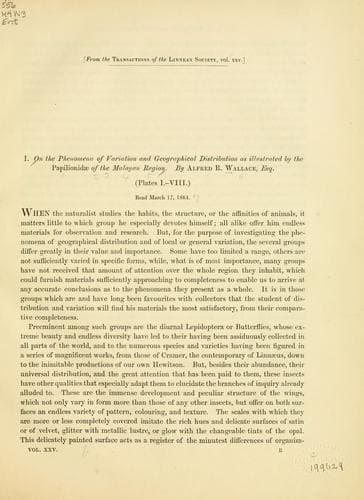
[_From the_ TRANSACTIONS _of the_ LINNEAN SOCIETY, vol. xxv.]
I. _On the Phenomena of Variation and Geographical Distribution as
illustrated by the_ Papilionidæ _of the Malayan Region. By_ ALFRED R.
WALLACE, _Esq._
(Plates I.–VIII.)
Read March 17, 1864.
When the naturalist studies the habits, the structure, or the affinities
of animals, it matters little to which group he especially devotes
himself; all alike offer him endless materials for observation and
research. But, for the purpose of investigating the phenomena of
geographical distribution and of local or general variation, the several
groups differ greatly in their value and importance. Some have too
limited a range, others are not sufficiently varied in specific forms,
while, what is of most importance, many groups have not received that
amount of attention over the whole region they inhabit, which could
furnish materials sufficiently approaching to completeness to enable us
to arrive at any accurate conclusions as to the phenomena they present
as a whole. It is in those groups which are and have long been
favourites with collectors that the student of distribution and
variation will find his materials the most satisfactory, from their
comparative completeness.
Preeminent among such groups are the diurnal Lepidoptera or Butterflies,
whose extreme beauty and endless diversity have led to their having been
assiduously collected in all parts of the world, and to the numerous
species and varieties having been figured in a series of magnificent
works, from those of Cramer, the contemporary of Linnæus, down to the
inimitable productions of our own Hewitson. But, besides their
abundance, their universal distribution, and the great attention that
has been paid to them, these insects have other qualities that
especially adapt them to elucidate the branches of inquiry already
alluded to. These are the immense development and peculiar structure of
the wings, which not only vary in form more than those of any other
insects, but offer on both surfaces an endless variety of pattern,
colouring, and texture. The scales with which they are more or less
completely covered imitate the rich hues and delicate surfaces of satin
or of velvet, glitter with metallic lustre, or glow with the changeable
tints of the opal. This delicately painted surface acts as a register of
the minutest differences of organization,—a shade of colour, an
additional streak or spot, a slight modification of outline continually
recurring with the greatest regularity and fixity, while the body and
all its other members exhibit no appreciable change. The wings of
Butterflies, as Mr. Bates has well put it[1], “serve as a tablet on
which Nature writes the story of the modifications of species;” they
enable us to perceive changes that would otherwise be uncertain and
difficult of observation, and exhibit to us on an enlarged scale the
Public-domain text, read in full here on John Shaqi.
Reviews
Reviews
No reviews yet
Be the first to share your thoughts on this work.
Join the Discussion
Join the discussion
Sign in to leave a comment or review.
Sign InorCreate an account