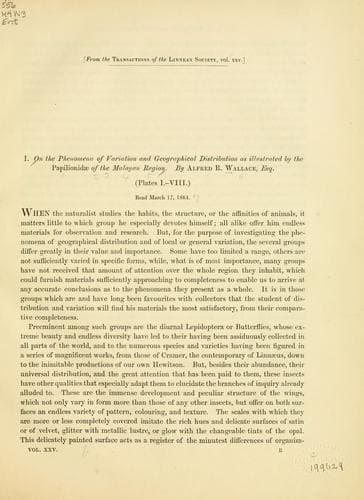
On the phenomena of variation and geographical distribution as illustrated by the Papilionidæ of the Malayan regionWallace, Alfred Russel
Science
On the phenomena of variation and geographical distribution as illustrated by the Papilionidæ of the Malayan region
Wallace, Alfred Russel
Papilionidae -- Malaysia -- Geographical distribution; Papilionidae -- Malaysia -- Variation
Carpenter’s ‘Introduction to the Study of the Foraminifera,’ he states
that “_there is not a single specimen of plant or animal of which the
range of variation has been studied by the collocation and comparison of
so large a number of specimens as have passed under the review of
Messrs. Williamson, Parker, Rupert Jones, and myself, in our studies of
the types of this group_;” and the result of this extended comparison of
specimens is stated to be, “_The range of variation is so great among
the Foraminifera as to include not merely those differential characters
which have been usually accounted_ SPECIFIC, _but also those upon which
the greater part of the_ GENERA _of this group have been founded, and
even in some instances those of its_ ORDERS” (Foraminifera, Preface, x).
Yet this same group had been divided by D’Orbigny and other authors into
a number of clearly defined _families_, _genera_, and _species_, which
these careful and conscientious researches have shown to have been
almost all founded on incomplete knowledge.
Footnote 5:
See Dr. J. E. Gray “On the Species of Lemuroids,” Proc. Zool. Soc.
1863, p. 134.
Professor DeCandolle has recently given the results of an extensive
review of the species of _Cupuliferæ_. He finds that the best-known
species of oaks are those which produce most varieties and subvarieties,
that they are often surrounded by provisional species; and, with the
fullest materials at his command, two-thirds of the species he considers
more or less doubtful. His general conclusion is, that “_in botany the
lowest series of groups_, SUBVARIETIES, VARIETIES, _and_ RACES _are very
badly limited; these can be grouped into_ SPECIES _a little less vaguely
limited, which again can be formed into sufficiently precise_ GENERA.”
This general conclusion is entirely objected to by the writer of the
article in the ‘Natural History Review,’ who, however, does not deny its
applicability to the particular order under discussion, while this very
difference of opinion is another proof that difficulties in the
determination of species do not, any more than in the higher groups,
vanish with increasing materials and more accurate research.
Another striking example of the same kind is seen in the genera _Rubus_
and _Rosa_, adduced by Mr. Darwin himself; for though the amplest
materials exist for a knowledge of these groups, and the most careful
research has been bestowed upon them, yet the various species have not
thereby been accurately limited and defined so as to satisfy the
majority of botanists.
Dr. Hooker seems to have found the same thing in his study of the Arctic
flora. For though he has had much of the accumulated materials of his
predecessors to work upon, he continually expresses himself as unable to
do more than group the numerous and apparently fluctuating forms into
more or less imperfectly defined species[6].
Footnote 6:
Public-domain text, read in full here on John Shaqi.
Reviews
Reviews
No reviews yet
Be the first to share your thoughts on this work.
Join the Discussion
Join the discussion
Sign in to leave a comment or review.
Sign InorCreate an account