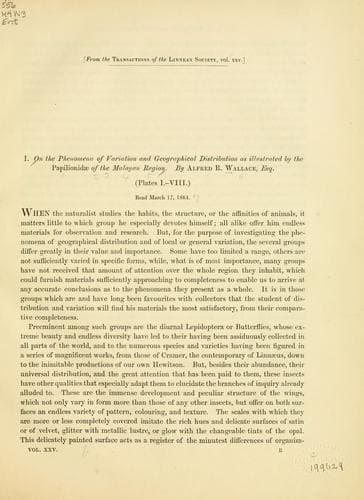
On the phenomena of variation and geographical distribution as illustrated by the Papilionidæ of the Malayan region — John Shaqi
On the phenomena of variation and geographical distribution as illustrated by the Papilionidæ of the Malayan regionWallace, Alfred Russel
Science
On the phenomena of variation and geographical distribution as illustrated by the Papilionidæ of the Malayan region
Wallace, Alfred Russel
Papilionidae -- Malaysia -- Geographical distribution; Papilionidae -- Malaysia -- Variation
_Variation as specially influenced by Locality._
The phenomena of variation as influenced by locality have not hitherto
received much attention. Botanists, it is true, are acquainted with the
influences of climate, altitude, and other physical conditions in
modifying the forms and external characteristics of plants; but I am not
aware that any peculiar influence has been traced to locality,
independent of climate. Almost the only case I can find recorded is
mentioned in that repertory of natural-history facts, ‘The Origin of
Species,’ viz. that herbaceous groups have a tendency to become arboreal
in islands. In the animal world, I cannot find that any facts have been
pointed out as showing the special influence of locality in giving a
peculiar _facies_ to the several disconnected species that inhabit it.
What I have to adduce on this matter will therefore, I hope, possess
some interest and novelty.
On examining the closely allied species, local forms, and varieties
distributed over the Indian and Malayan regions, I find that larger or
smaller districts, or even single islands, give a special character to
the majority of their Papilionidæ. For instance: 1. The species of the
Indian region (Sumatra, Java, and Borneo) are almost invariably smaller
than the allied species inhabiting Celebes and the Moluccas; 2. The
species of New Guinea and Australia are also, though in a less degree,
smaller than the nearest species or varieties of the Moluccas; 3. In the
Moluccas themselves the species of Amboyna are the largest; 4. The
species of Celebes equal or even surpass in size those of Amboyna; 5.
The species and varieties of Celebes possess a striking character in the
form of the anterior wings, different from that of the allied species
and varieties of all the surrounding islands; 6. Tailed species in India
or the Indian region become tailless as they spread eastward through the
archipelago.
Having preserved the finest and largest specimens of Butterflies in my
own collection, and having always taken for comparison the largest
specimens of the same sex, I believe that the tables I now give are
sufficiently exact. The differences of expanse of wings are in most
cases very great, and are much more conspicuous in the specimens
themselves than on paper. It will be seen that no less than fourteen
Papilionidæ inhabiting Celebes and the Moluccas are from one-third to
one-half greater in extent of wing than the allied species representing
them in Java, Sumatra, and Borneo. Six species inhabiting Amboyna are
larger than the closely allied forms of the northern Moluccas and New
Guinea by about one-sixth. These include almost every case in which
closely allied species can be compared.
PAPILIONIDÆ.
Public-domain text, read in full here on John Shaqi.
Reviews
Reviews
No reviews yet
Be the first to share your thoughts on this work.
Join the Discussion
Join the discussion
Sign in to leave a comment or review.
Sign InorCreate an account