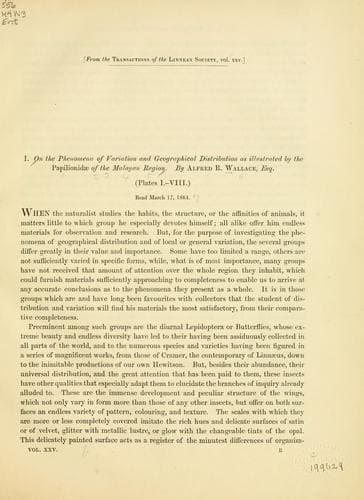
On the phenomena of variation and geographical distribution as illustrated by the Papilionidæ of the Malayan regionWallace, Alfred Russel
Science
On the phenomena of variation and geographical distribution as illustrated by the Papilionidæ of the Malayan region
Wallace, Alfred Russel
Papilionidae -- Malaysia -- Geographical distribution; Papilionidae -- Malaysia -- Variation
_Under side_: the anterior wings have distinct greyish lines of scales
between the nervures in the apical region; posterior wings not dotted
with scales as in _P. Severus_, but with two or three single rows of
scales in the cell only; the yellowish band consisting of a lunule next
the upper margin, followed by three rhomboidal spots notched below, of
which the middle one is the largest, then a roundish spot and a small
horizontal mark; a row of seven submarginal lunules, of which the three
middle ones are smallest and nearly obsolete, and that at the anal angle
much the largest and, with the whitish marginal spot below it, forming
an incomplete ocellus.
Expanse of wings 3½–3¾ inches.
_Hab._ New Guinea (♂) (_Wall._).
55. PAPILIO PHESTUS, Guérin.
_P. Phestus_, Guér. Voyage de la Coquille, t. 14. f. 2; Bd. Voy. de
l’Astrolabe, i. p. 41; Sp. Gén. Lép. p. 212.
_Hab._ New Guinea (_Paris Museum_).
56. PAPILIO HELENUS, Linnæus.
_P. Helenus_, L.; Cramer, Pap. Ex. t. 153. f. A, B; Lucas, Lep. Ex. t.
15. f. 2; Boisd. Sp. Gén. Lép. p. 211.
_Hab._ China (“_type_,” _Cramer’s figure_).
Local form _a_. Has more falcate wings and longer tail; the red marks at
the anal angle beneath are divided by a violet-white mark.
_Hab._ North India.
Local form _b_. Same form of wings as the last, but smaller; the third
and fourth lunules from the anal angle beneath very small or quite
absent.
_Hab._ Java, Sumatra (_Wall._).
57. PAPILIO HECUBA, n. s. Tab. V. fig. 3 (♂).
Upper wings falcate, and their outer margin much hollowed out, as in
many of the Celebes butterflies.
♂. _Upper side_: the outer half of the anterior wings of a fine cottony
texture, as in _P. Helenus_, but more marked; the red lunule at the anal
angle wanting; the rest as in _P. Helenus_.
_Under side_: the lunules and ocelli are ochre-yellow instead of deep
red, the two outer ones very small, the third almost obsolete, and the
next two absent; the anal ocellus is bordered with blue above, and
adjoining it is a blue lunule in the place of the red one in _P.
Helenus_.
♀. _Upper side_: of a browner colour; two orange-brown ocelli at the
anal angle.
_Under side_: the lunules and ocelli all larger; the two intermediate
ones entirely absent, as in the male.
Expanse of wings 5½–5¾ inches.
_Hab._ Macassar, Menado (Celebes) (_Wall._).
58. PAPILIO ISWARA, White.
_P. Iswara_, White, Entom. 1842, p. 280; Doub. and Hew. Gen. of Diurn.
Lep. pl. 2. f. 1 (♀).
_Hab._ Penang, Malacca, Singapore, Borneo (♂, ♀) (_Wall._).
59. PAPILIO HYSTASPES, Felder.
_P. Hystaspes_, Feld. Lep. Nov. Philipp. p. 12.
_Hab._ Luzon (Philippines).
This is the Philippine form of _P. Helenus_.
60. PAPILIO ARASPES, Felder.
_P. Araspes_, Feld. Ent. Fragm. p. 17.
_Hab._ Philippine Islands.
This comes near to _P. Iswara_.
61. PAPILIO NEPHELUS, Boisduval.
_P. Nephelus_, Bd. Sp. Gén. Lép. p. 210; De Haan, Verh. Nat. Gesch. p.
29, t. 4. f. 4, ♂.
Public-domain text, read in full here on John Shaqi.
Reviews
Reviews
No reviews yet
Be the first to share your thoughts on this work.
Elsewhere in the archive
Join the Discussion
Join the discussion
Sign in to leave a comment or review.
Sign InorCreate an account