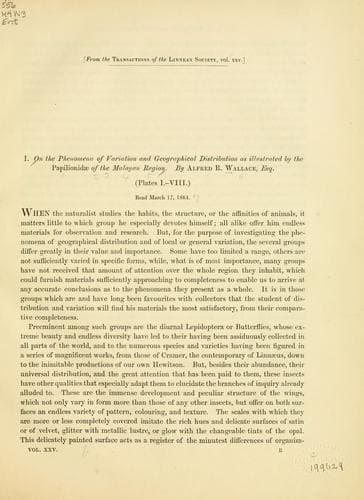
On the phenomena of variation and geographical distribution as illustrated by the Papilionidæ of the Malayan regionWallace, Alfred Russel
Science
On the phenomena of variation and geographical distribution as illustrated by the Papilionidæ of the Malayan region
Wallace, Alfred Russel
Papilionidae -- Malaysia -- Geographical distribution; Papilionidae -- Malaysia -- Variation
_Male._ Above:—anterior wings as in _P. Ambrax_; posterior wings more
elongate, the white band much narrower, notched behind at the nervures,
with the portions between regularly rounded; the part which crosses the
cell is cut by black nervures, and there is an oblique red mark at the
anal angle.
Beneath:—with a submarginal of seven lunules on the hinder wings, the
one above the anal angle very large; whereas the last two species have
one small lunule only beneath, at the anal angle.
_Female._ Is probably that figured in ‘Voy. au Pôle Sud,’ Lép. t. 1, f.
5, which resembles most the female of _P. Ambracia_, but differs in the
form of the white and red patches. It is said to be from “the coasts of
New Guinea”; but as the expedition touched at the Aru Islands, it is
very probable that there is an error of locality, as I have ascertained
to be very often the case in the indications furnished by these and
other ‘Voyages.’
_Hab._ Aru Islands (_Wall._).
70. PAPILIO DUNALI, Montrouzier.
_P. Dunali_, Mont. Ann. Soc. d’Agricult. de Lyon, 1856, p. 394.
_Hab._ Woodlark Island (S.E. of New Guinea).
_Remark._—This seems closely allied to the last species.
i. _Erectheus_ group.
71. PAPILIO ORMENUS, Guérin. Tab. III. figs. 2 (♂), 1, 3, 4 (♀ ♀).
_P. Ormenus_, Guér. Voy. de la Coquille, pl. 14. f. 3; Boisd. Sp. Gén.
Lép. p. 211.
_P. Erectheus_, var., Voy. au Pôle Sud, Lép. t. 1. f. 1, 2.
_P. Amanga_, Boisd. Sp. Gén. p. 216, ♀ (_P. Onesimus_, Hew. Ex. Butt.
Pap. iii. f. 8).
_Hab._ Waigiou, Aru Isl., Ké Isl., Matabello and Goram Isl. (_Wall._).
This belongs to a remarkable group of Papilios inhabiting the
Austro-Malayan region, and which are especially interesting as
exhibiting a good instance of polymorphism, the females being of two or
three distinct forms.
The male in this species is characterized by the small amount of marking
on the under surface.
_1st form_ of female. Tab. III. fig. 1.
Almost exactly intermediate between the male and the normal female,
which resembles _P. Erectheus_ ♀.
Upper side brown-black; a band of four whitish-yellow spots across the
anterior wings beyond the cell, the upper one of the same size and
position as in the male, the 2nd and 3rd elongated towards the cell, the
4th rather shorter than the 3rd, and immediately beneath it. Posterior
wings with a central patch of a pale sulphur-yellow just crossing the
end of the cell, and separated below into five truncate lobes; below
this, and next the anal margin, are two irregular blue lunules, with a
red lunule at the anal angle and a smaller one lower down beneath the
second blue lunule.
Under side as above; on the hind wings the upper half of the yellow
patch is dusky, and there is a complete submarginal series of seven red
lunules.
_Hab._ Waigiou (a single specimen) (_Wall._).
_2nd form_ of female. Tab. III. fig. 3.
Public-domain text, read in full here on John Shaqi.
Reviews
Reviews
No reviews yet
Be the first to share your thoughts on this work.
Elsewhere in the archive
Join the Discussion
Join the discussion
Sign in to leave a comment or review.
Sign InorCreate an account