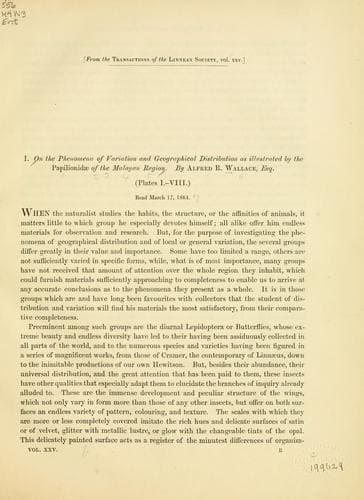
On the phenomena of variation and geographical distribution as illustrated by the Papilionidæ of the Malayan regionWallace, Alfred Russel
Science
On the phenomena of variation and geographical distribution as illustrated by the Papilionidæ of the Malayan region
Wallace, Alfred Russel
Papilionidae -- Malaysia -- Geographical distribution; Papilionidae -- Malaysia -- Variation
In referring to the species described by Dr. Felder, I have quoted from
papers which he has sent me, with distinct titles and separate paging,
but which were all first published in the ‘Wiener Entomologischen
Monatschrift,’ viz. “Lepidopterologische Fragmente” (quoted as “Lep.
Fragm.”), published at intervals from June 1859 to August 1860,
“Lepidoptera Nova Malayica” (quoted as “Lep. Nov. Mal.”), published in
1860, and “Lepidoptera Nova a Dr. Carolo Semper in insulis Philippinis
collecta” (quoted as “Lep. Nov. Philipp.”), published in 1861. It is to
be regretted that the titles and paging of these separate papers were
not made to correspond with the original publication, so as to have made
a more exact reference possible.
I have also quoted Zinken’s ‘Beitrag zur Insecten-Fauna von Java’
separated from the ‘Nova Acta Acad. Nat. Curios.’; but in this case the
pages and the numbering of the plates have been preserved as in the
original work.
EXPLANATION OF THE PLATES.
PLATE I.
Represents the various forms of _Papilio Memnon_ (see pages 6 and 46).
N.B. The left side of each figure shows the upper surface, and the
right side the under surface of the same insect.
Fig. 1. A male, from Borneo (a slight local variety).
Fig. 2. A female, from Java (a variety like _P. Agenor_, Cr.).
Fig. 3. A female, from Sumatra (a variety near _P. Anceus_, Cr.). The
last two are varieties of the 1st dimorphic form of female in this
species.
Fig. 4. A female, from Java (_P. Achates_, Cr.). The 2nd dimorphic
form of female of _Papilio Memnon_.
PLATE II.
Represents the various forms of _Papilio Pammon_ (figs. 1, 3, 5, and
6) and _P. Theseus_ (figs. 2, 4, and 7). (See pages 6, 7, 51, 52,
and 53.) N.B. The left side of each figure shows the upper surface,
and the right side the under surface of the same insect.
Fig. 1. _Papilio Pammon_; a male, from Malacca.
Fig. 3. The first form of female, closely resembling the male, from
India.
Fig. 5. The second form of female (_P. Polytes_, L.), from Singapore.
This is the most common and widely distributed form of female,
occurring everywhere with the male.
Fig. 6. The third form of female (_P. Romulus_, Cr.), from India.
Fig. 2. _Papilio Theseus_, the first form of female, almost exactly
resembling the male, from Timor. This form is very rare.
Fig. 4. The second form of female, from Timor.
Fig. 7. The third form of female (_P. Theseus_, Cr.), from Sumatra.
The second and third forms of female seem about equally plentiful,
but are generally confined to separate islands. A fourth form of
female (_P. Melanides_, De Haan) would have been figured, but could
not be brought on to the plate. (See pages 7 and 53.)
PLATE III.
Public-domain text, read in full here on John Shaqi.
Reviews
Reviews
No reviews yet
Be the first to share your thoughts on this work.
Elsewhere in the archive
Join the Discussion
Join the discussion
Sign in to leave a comment or review.
Sign InorCreate an account