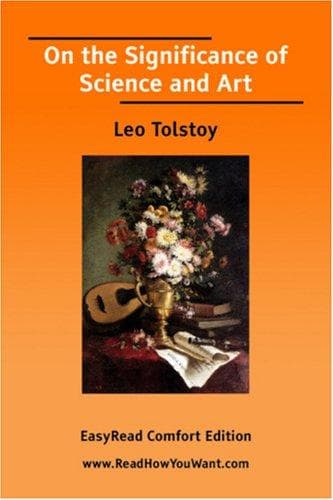
On the Significance of Science and Art — John Shaqi
On the Significance of Science and ArtTolstoy, Leo, graf
Philosophy
On the Significance of Science and Art
Tolstoy, Leo, graf
Art and science; Literature; Philosophy; Tolstoy, Leo, graf, 1828-1910 -- Philosophy
The thinker or the artist will never sit calmly on Olympian heights, as
we have become accustomed to represent them to ourselves. The thinker or
the artist should suffer in company with the people, in order that he may
find salvation or consolation. Besides this, he will suffer because he
is always and eternally in turmoil and agitation: he might decide and say
that that which would confer welfare on men, would free them from
suffering, would afford them consolation; but he has not said so, and has
not presented it as he should have done; he has not decided, and he has
not spoken; and to-morrow, possibly, it will be too late,--he will die.
And therefore suffering and self-sacrifice will always be the lot of the
thinker and the artist.
Not of this description will be the thinker and artist who is reared in
an establishment where, apparently, they manufacture the learned man or
the artist (but in point of fact, they manufacture destroyers of science
and of art), who receives a diploma and a certificate, who would be glad
not to think and not to express that which is imposed on his soul, but
who cannot avoid doing that to which two irresistible forces draw him,--an
inward prompting, and the demand of men.
There will be no sleek, plump, self-satisfied thinkers and artists.
Spiritual activity, and its expression, which are actually necessary to
others, are the most burdensome of all man's avocations; a cross, as the
Gospels phrase it. And the sole indubitable sign of the presence of a
vocation is self-devotion, the sacrifice of self for the manifestation of
the power that is imposed upon man for the benefit of others.
It is possible to study out how many beetles there are in the world, to
view the spots on the sun, to write romances and operas, without
suffering; but it is impossible, without self-sacrifice, to instruct
people in their true happiness, which consists solely in renunciation of
self and the service of others, and to give strong expression to this
doctrine, without self-sacrifice.
Christ did not die on the cross in vain; not in vain does the sacrifice
of suffering conquer all things.
But our art and science are provided with certificates and diplomas; and
the only anxiety of all men is, how to still better guarantee them, i.e.,
how to render the service of the people impracticable for them.
True art and true science possess two unmistakable marks: the first, an
inward mark, which is this, that the servitor of art and science will
fulfil his vocation, not for profit but with self-sacrifice; and the
second, an external sign,--his productions will be intelligible to all
the people whose welfare he has in view.
Public-domain text, read in full here on John Shaqi.
Reviews
Reviews
No reviews yet
Be the first to share your thoughts on this work.
Join the Discussion
Join the discussion
Sign in to leave a comment or review.
Sign InorCreate an account