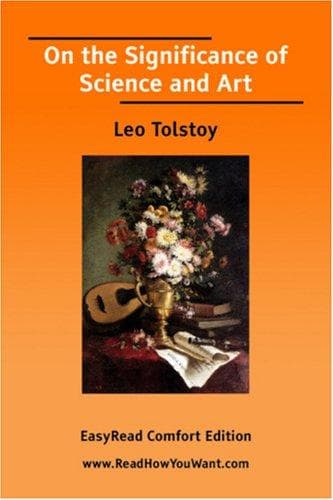
On the Significance of Science and ArtTolstoy, Leo, graf
Philosophy
On the Significance of Science and Art
Tolstoy, Leo, graf
Art and science; Literature; Philosophy; Tolstoy, Leo, graf, 1828-1910 -- Philosophy
But, in spite of the arbitrariness and incorrectness of the fundamental
assumption of positive philosophy, it was accepted by the so-called
cultivated world with the greatest sympathy. In this connection, one
thing is worthy of note: that out of the works of Comte, consisting of
two parts, of positive philosophy and of positive politics, only the
first was adopted by the learned world,--that part which justifieth, on
new promises, the existent evil of human societies; but the second part,
treating of the moral obligations of altruism, arising from the
recognition of mankind as an organism, was regarded as not only of no
importance, but as trivial and unscientific. It was a repetition of the
same thing that had happened in the case of Kant's works. The "Critique
of Pure Reason" was adopted by the scientific crowd; but the "Critique of
Applied Reason," that part which contains the gist of moral doctrine, was
repudiated. In Kant's doctrine, that was accepted as scientific which
subserved the existent evil. But the positive philosophy, which was
accepted by the crowd, was founded on an arbitrary and erroneous basis,
was in itself too unfounded, and therefore unsteady, and could not
support itself alone. And so, amid all the multitude of the idle plays
of thought of the men professing the so-called science, there presents
itself an assertion equally devoid of novelty, and equally arbitrary and
erroneous, to the effect that living beings, i.e., organisms, have had
their rise in each other,--not only one organism from another, but one
from many; i.e., that in a very long interval of time (in a million of
years, for instance), not only could a duck and a fish proceed from one
ancestor, but that one animal might result from a whole hive of bees. And
this arbitrary and erroneous assumption was accepted by the learned world
with still greater and more universal sympathy. This assumption was
arbitrary, because no one has ever seen how one organism is made from
another, and therefore the hypothesis as to the origin of species will
always remain an hypothesis, and not an experimental fact. And this
hypothesis was also erroneous, because the decision of the question as to
the origin of species--that they have originated, in consequence of the
law of heredity and fitness, in the course of an interminably long
time--is no solution at all, but merely a re-statement of the problem in
a new form.
Public-domain text, read in full here on John Shaqi.
Reviews
Reviews
No reviews yet
Be the first to share your thoughts on this work.
Join the Discussion
Join the discussion
Sign in to leave a comment or review.
Sign InorCreate an account