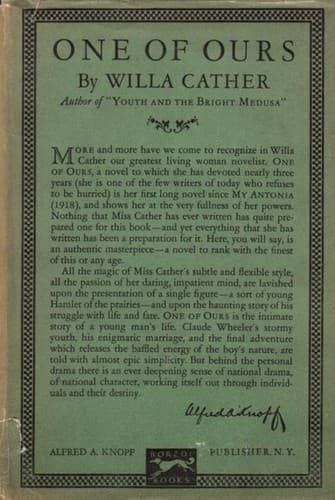
Farm life -- Fiction; Nebraska -- Fiction; Soldiers -- Fiction; War stories; World War, 1914-1918 -- Fiction
III
After the heavy work of harvest was over, Mrs. Wheeler often
persuaded her husband, when he was starting off in his buckboard,
to take her as far as Claude's new house. She was glad Enid
didn't keep her parlour dark, as Mrs. Royce kept hers. The doors
and windows were always open, the vines and the long petunias in
the window-boxes waved in the breeze, and the rooms were full of
sunlight and in perfect order. Enid wore white dresses about her
work, and white shoes and stockings. She managed a house easily
and systematically. On Monday morning Claude turned the washing
machine before he went to work, and by nine o'clock the clothes
were on the line. Enid liked to iron, and Claude had never before
in his life worn so many clean shirts, or worn them with such
satisfaction. She told him he need not economize in working
shirts; it was as easy to iron six as three.
Although within a few months Enid's car travelled more than two
thousand miles for the Prohibition cause, it could not be said
that she neglected her house for reform. Whether she neglected
her husband depended upon one's conception of what was his due.
When Mrs. Wheeler saw how well their little establishment was
conducted, how cheerful and attractive Enid looked when one
happened to drop in there, she wondered that Claude was not
happy. And Claude himself wondered. If his marriage disappointed
him in some respects, he ought to be a man, he told himself, and
make the best of what was good in it. If his wife didn't love
him, it was because love meant one thing to him and quite another
thing to her. She was proud of him, was glad to see him when he
came in from the fields, and was solicitous for his comfort.
Everything about a man's embrace was distasteful to Enid;
something inflicted upon women, like the pain of childbirth,--
for Eve's transgression, perhaps.
This repugnance was more than physical; she disliked ardour of
any kind, even religious ardour. She had been fonder of Claude
before she married him than she was now; but she hoped for a
readjustment. Perhaps sometime she could like him again in
exactly the same way. Even Brother Weldon had hinted to her that
for the sake of their future tranquillity she must be lenient
with the boy. And she thought she had been lenient. She could not
understand his moods of desperate silence, the bitter, biting
remarks he sometimes dropped, his evident annoyance if she went
over to join him in the timber claim when he lay there idle in
the deep grass on a Sunday afternoon.
Claude used to lie there and watch the clouds, saying to himself,
"It's the end of everything for me." Other men than he must have
been disappointed, and he wondered how they bore it through a
lifetime. Claude had been a well behaved boy because he was an
idealist; he had looked forward to being wonderfully happy in
love, and to deserving his happiness. He had never dreamed that
it might be otherwise.
Public-domain text, read in full here on John Shaqi.
Reviews
Reviews
No reviews yet
Be the first to share your thoughts on this work.
Elsewhere in the archive
Join the Discussion
Join the discussion
Sign in to leave a comment or review.
Sign InorCreate an account