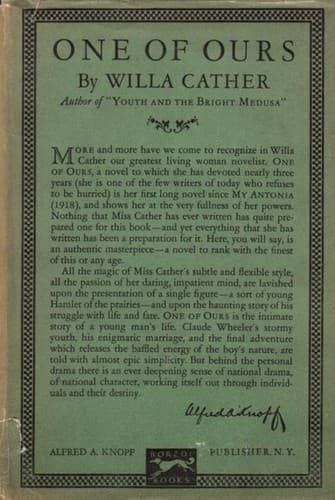
Farm life -- Fiction; Nebraska -- Fiction; Soldiers -- Fiction; War stories; World War, 1914-1918 -- Fiction
Sometimes now, when he went out into the fields on a bright
summer morning, it seemed to him that Nature not only smiled, but
broadly laughed at him. He suffered in his pride, but even more
in his ideals, in his vague sense of what was beautiful. Enid
could make his life hideous to him without ever knowing it. At
such times he hated himself for accepting at all her grudging
hospitality. He was wronging something in himself.
In her person Enid was still attractive to him. He wondered why
she had no shades of feeling to correspond to her natural grace
and lightness of movement, to the gentle, almost wistful
attitudes of body in which he sometimes surprised her. When he
came in from work and found her sitting on the porch, leaning
against a pillar, her hands clasped about her knees, her head
drooping a little, he could scarcely believe in the rigidity
which met him at every turn. Was there something repellent in
him? Was it, after all, his fault?
Enid was rather more indulgent with his father than with any one
else, he noticed. Mr. Wheeler stopped to see her almost every
day, and even took her driving in his old buckboard. Bayliss came
out from town to spend the evening occasionally. Enid's
vegetarian suppers suited him, and as she worked with him in the
Prohibition campaign, they always had business to discuss.
Bayliss had a social as well as a hygienic prejudice against
alcohol, and he hated it less for the harm it did than for the
pleasure it gave. Claude consistently refused to take any part in
the activities of the Anti-Saloon League, or to distribute what
Bayliss and Enid called "our literature."
In the farming towns the term "literature" was applied only to a
special kind of printed matter; there was Prohibition literature,
Sex-Hygiene literature, and, during a scourge of cattle disease,
there was Hoof-and-Mouth literature. This special application of
the word didn't bother Claude, but his mother, being an
old-fashioned school-teacher, complained about it.
Enid did not understand her husband's indifference to a burning
question, and could only attribute it to the influence of Ernest
Havel. She sometimes asked Claude to go with her to one of her
committee meetings. If it was a Sunday, he said he was tired and
wanted to read the paper. If it was a week-day, he had something
to do at the barn, or meant to clear out the timber claim. He
did, indeed, saw off a few dead limbs, and cut down a tree the
lightning had blasted. Further than that he wouldn't have let
anybody clear the timber lot; he would have died defending it.
Public-domain text, read in full here on John Shaqi.
Reviews
Reviews
No reviews yet
Be the first to share your thoughts on this work.
Elsewhere in the archive
Join the Discussion
Join the discussion
Sign in to leave a comment or review.
Sign InorCreate an account