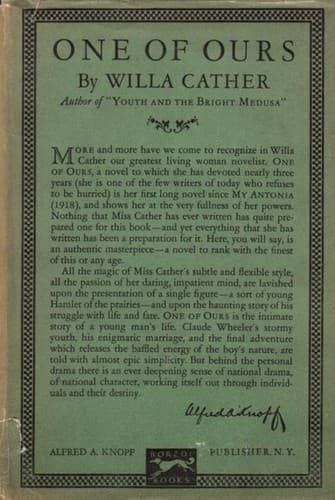
Farm life -- Fiction; Nebraska -- Fiction; Soldiers -- Fiction; War stories; World War, 1914-1918 -- Fiction
Mrs. Wheeler looked up at him. "I don't see how we can stay out
of it much longer, do you? I suppose our army wouldn't be a drop
in the bucket, even if we could get it over. They tell us we can
be more useful in our agriculture and manufactories than we could
by going into the war. I only hope it isn't campaign talk. I do
distrust the Democrats."
Claude laughed. "Why, Mother, I guess there's no party politics
in this."
She shook her head. "I've never yet found a public question in
which there wasn't party politics. Well, we can only do our duty
as it comes to us, and have faith. This field finishes your fall
work?"
"Yes. I'll have time to do some things about the place, now. I'm
going to make a good ice-house and put up my own ice this
winter."
"Were you thinking of going up to Lincoln, for a little?"
"I guess not."
Mrs. Wheeler sighed. His tone meant that he had turned his back
on old pleasures and old friends.
"Have you and Enid taken tickets for the lecture course in
Frankfort?"
"I think so, Mother," he answered a little impatiently. "I told
her she could attend to it when she was in town some day."
"Of course," his mother persevered, "some of the programs are not
very good, but we ought to patronize them and make the best of
what we have."
He knew, and his mother knew, that he was not very good at that.
His horses stopped at the water tank. "Don't wait for me. I'll be
along in a minute." Seeing her crestfallen face, he smiled.
"Never mind, Mother, I can always catch you when you try to give
me a pill in a raisin. One of us has to be pretty smart to fool
the other."
She blinked up at him with that smile in which her eyes almost
disappeared. "I thought I was smart that time!"
It was a comfort, she reflected, as she hurried up the hill, to
get hold of him again, to get his attention, even.
While Claude was washing for dinner, Mahailey came to him with a
page of newspaper cartoons, illustrating German brutality. To her
they were all photographs,--she knew no other way of making a
picture.
"Mr. Claude," she asked, "how comes it all them Germans is such
ugly lookin' people? The Yoeders and the German folks round here
ain't ugly lookin'."
Claude put her off indulgently. "Maybe it's the ugly ones that
are doing the fighting, and the ones at home are nice, like our
neighbours."
"Then why don't they make their soldiers stay home, an' not go
breakin' other people's things, an' turnin' 'em out of their
houses," she muttered indignantly. "They say little babies was
born out in the snow last winter, an' no fires for their mudders
nor nothin'. 'Deed, Mr. Claude, it wasn't like that in our war;
the soldiers didn't do nothin' to the women an' chillun. Many a
time our house was full of Northern soldiers, an' they never so
much as broke a piece of my mudder's chiney."
Public-domain text, read in full here on John Shaqi.
Reviews
Reviews
No reviews yet
Be the first to share your thoughts on this work.
Elsewhere in the archive
Join the Discussion
Join the discussion
Sign in to leave a comment or review.
Sign InorCreate an account