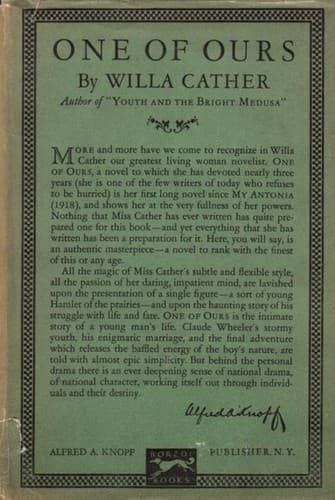
Farm life -- Fiction; Nebraska -- Fiction; Soldiers -- Fiction; War stories; World War, 1914-1918 -- Fiction
"You'll have to tell me about it again sometime, Mahailey. I must
have my dinner and get back to work. If we don't get our wheat
in, those people over there won't have anything to eat, you
know."
The picture papers meant a great deal to Mahailey, because she
could faintly remember the Civil War. While she pored over
photographs of camps and battlefields and devastated villages,
things came back to her; the companies of dusty Union infantry
that used to stop to drink at her mother's cold mountain spring.
She had seen them take off their boots and wash their bleeding
feet in the run. Her mother had given one louse-bitten boy a
clean shirt, and she had never forgotten the sight of his back,
"as raw as beef where he'd scratched it." Five of her brothers
were in the Confederate army. When one was wounded in the second
battle of Bull Run, her mother had borrowed a wagon and horses,
gone a three days' journey to the field hospital, and brought the
boy home to the mountain. Mahailey could remember how her older
sisters took turns pouring cold spring water on his gangrenous
leg all day and all night. There were no doctors left in the
neighbourhood, and as nobody could amputate the boy's leg, he
died by inches. Mahailey was the only person in the Wheeler
household who had ever seen war with her own eyes, and she felt
that this fact gave her a definite superiority.
V
Claude had been married a year and a half. One December morning
he got a telephone message from his father-in-law, asking him to
come in to Frankfort at once. He found Mr. Royce sunk in his
desk-chair, smoking as usual, with several foreign-looking
letters on the table before him. As he took these out of their
envelopes and sorted the pages, Claude noticed how unsteady his
hands had become.
One letter, from the chief of the medical staff in the mission
school where Caroline Royce taught, informed Mr. Royce that his
daughter was seriously ill in the mission hospital. She would
have to be sent to a more salubrious part of the country for rest
and treatment, and would not be strong enough to return to her
duties for a year or more. If some member of her family could
come out to take care of her, it would relieve the school
authorities of great anxiety. There was also a letter from a
fellow teacher, and a rather incoherent one from Caroline
herself. After Claude finished reading them, Mr. Royce pushed a
box of cigars toward him and began to talk despondently about
missionaries.
Public-domain text, read in full here on John Shaqi.
Reviews
Reviews
No reviews yet
Be the first to share your thoughts on this work.
Elsewhere in the archive
Join the Discussion
Join the discussion
Sign in to leave a comment or review.
Sign InorCreate an account