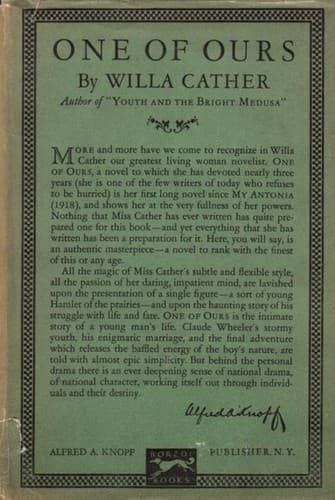
Farm life -- Fiction; Nebraska -- Fiction; Soldiers -- Fiction; War stories; World War, 1914-1918 -- Fiction
When Ernest left, Claude walked as far as the Yoeders' place with
him, and came back across the snow-drifted fields, under the
frosty brilliance of the winter stars. As he looked up at them,
he felt more than ever that they must have something to do with
the fate of nations, and with the incomprehensible things that
were happening in the world. In the ordered universe there must
be some mind that read the riddle of this one unhappy planet,
that knew what was forming in the dark eclipse of this hour. A
question hung in the air; over all this quiet land about him,
over him, over his mother, even. He was afraid for his country,
as he had been that night on the State House steps in Denver,
when this war was undreamed of, hidden in the womb of time.
Claude and his mother had not long to wait. Three days later they
knew that the German ambassador had been dismissed, and the
American ambassador recalled from Berlin. To older men these
events were subjects to think and converse about; but to boys
like Claude they were life and death, predestination.
VII
One stormy morning Claude was driving the big wagon to town to
get a load of lumber. The roads were beginning to thaw out, and
the country was black and dirty looking. Here and there on the
dark mud, grey snow crusts lingered, perforated like honeycomb,
with wet weedstalks sticking up through them. As the wagon
creaked over the high ground just above Frankfort, Claude noticed
a brilliant new flag flying from the schoolhouse cupola. He had
never seen the flag before when it meant anything but the Fourth
of July, or a political rally. Today it was as if he saw it for
the first time; no bands, no noise, no orators; a spot of
restless colour against the sodden March sky.
He turned out of his way in order to pass the High School, drew
up his team, and waited a few minutes until the noon bell rang.
The older boys and girls came out first, with a flurry of
raincoats and umbrellas. Presently he saw Gladys Farmer, in a
yellow "slicker" and an oilskin hat, and waved to her. She came
up to the wagon.
"I like your decoration," he said, glancing toward the cupola.
"It's a silk one the Senior boys bought with their athletic
money. I advised them not to run it up in this rain, but the
class president told me they bought that flag for storms."
"Get in, and I'll take you home."
She took his extended hand, put her foot on the hub of the wheel,
and climbed to the seat beside him. He clucked to his team.
"So your High School boys are feeling war-like these days?"
"Very. What do you think?"
"I think they'll have a chance to express their feelings."
"Do you, Claude? It seems awfully unreal."
"Nothing else seems very real, either. I'm going to haul out a
load of lumber, but I never expect to drive a nail in it. These
things don't matter now. There is only one thing we ought to do,
and only one thing that matters; we all know it."
"You feel it's coming nearer every day?"
"Every day."
Public-domain text, read in full here on John Shaqi.
Reviews
Reviews
No reviews yet
Be the first to share your thoughts on this work.
Elsewhere in the archive
Join the Discussion
Join the discussion
Sign in to leave a comment or review.
Sign InorCreate an account