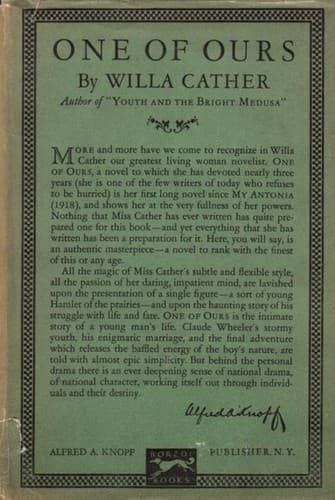
Farm life -- Fiction; Nebraska -- Fiction; Soldiers -- Fiction; War stories; World War, 1914-1918 -- Fiction
Gladys made no reply. She only looked at him gravely with her
calm, generous brown eyes. They stopped before the low house
where the windows were full of flowers. She took his hand and
swung herself to the ground, holding it for a moment while she
said good-bye. Claude drove back to the lumber yard. In a place
like Frankfort, a boy whose wife was in China could hardly go to
see Gladys without causing gossip.
VIII
During the bleak month of March Mr. Wheeler went to town in his
buckboard almost every day. For the first time in his life he had
a secret anxiety. The one member of his family who had never
given him the slightest trouble, his son Bayliss, was just now
under a cloud.
Bayliss was a Pacifist, and kept telling people that if only the
United States would stay out of this war, and gather up what
Europe was wasting, she would soon be in actual possession of the
capital of the world. There was a kind of logic in Bayliss'
utterances that shook Nat Wheeler's imperturbable assumption that
one point of view was as good as another. When Bayliss fought the
dram and the cigarette, Wheeler only laughed. That a son of his
should turn out a Prohibitionist, was a joke he could appreciate.
But Bayliss' attitude in the present crisis disturbed him. Day
after day he sat about his son's place of business, interrupting
his arguments with funny stories. Bayliss did not go home at all
that month. He said to his father, "No, Mother's too violent. I'd
better not."
Claude and his mother read the papers in the evening, but they
talked so little about what they read that Mahailey inquired
anxiously whether they weren't still fighting over yonder. When
she could get Claude alone for a moment, she pulled out Sunday
supplement pictures of the devastated countries and asked him to
tell her what was to become of this family, photographed among
the ruins of their home; of this old woman, who sat by the
roadside with her bundles. "Where's she goin' to, anyways? See,
Mr. Claude, she's got her iron cook-pot, pore old thing, carryin'
it all the way!"
Pictures of soldiers in gas-masks puzzled her; gas was something
she hadn't learned about in the Civil War, so she worked it out
for herself that these masks were worn by the army cooks, to
protect their eyes when they were cutting up onions! "All them
onions they have to cut up, it would put their eyes out if they
didn't wear somethin'," she argued.
On the morning of the eighth of April Claude came downstairs
early and began to clean his boots, which were caked with dry
mud. Mahailey was squatting down beside her stove, blowing and
puffing into it. The fire was always slow to start in heavy
weather. Claude got an old knife and a brush, and putting his
foot on a chair over by the west window, began to scrape his
shoe. He had said good-morning to Mahailey, nothing more. He
hadn't slept well, and was pale.
Public-domain text, read in full here on John Shaqi.
Reviews
Reviews
No reviews yet
Be the first to share your thoughts on this work.
Elsewhere in the archive
Join the Discussion
Join the discussion
Sign in to leave a comment or review.
Sign InorCreate an account