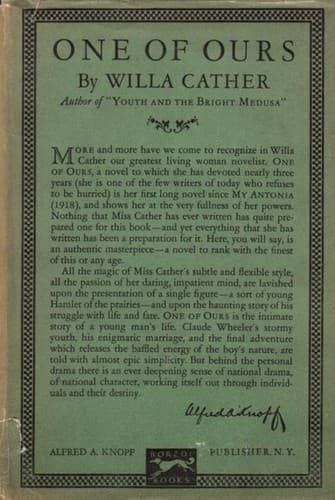
Farm life -- Fiction; Nebraska -- Fiction; Soldiers -- Fiction; War stories; World War, 1914-1918 -- Fiction
Mahailey had come to them long ago, when Claude was only a few
months old. She had been brought West by a shiftless Virginia
family which went to pieces and scattered under the rigours of
pioneer farm-life. When the mother of the family died, there was
nowhere for Mahailey to go, and Mrs. Wheeler took her in.
Mahailey had no one to take care of her, and Mrs. Wheeler had no
one to help her with the work; it had turned out very well.
Mahailey had had a hard life in her young days, married to a
savage mountaineer who often abused her and never provided for
her. She could remember times when she sat in the cabin, beside
an empty meal-barrel and a cold iron pot, waiting for "him" to
bring home a squirrel he had shot or a chicken he had stolen. Too
often he brought nothing but a jug of mountain whiskey and a pair
of brutal fists. She thought herself well off now, never to have
to beg for food or go off into the woods to gather firing, to be
sure of a warm bed and shoes and decent clothes. Mahailey was one
of eighteen children; most of them grew up lawless or
half-witted, and two of her brothers, like her husband, ended
their lives in jail. She had never been sent to school, and could
not read or write. Claude, when he was a little boy, tried to
teach her to read, but what she learned one night she had
forgotten by the next. She could count, and tell the time of day
by the clock, and she was very proud of knowing the alphabet and
of being able to spell out letters on the flour sacks and coffee
packages. "That's a big A." she would murmur, "and that there's a
little a."
Mahailey was shrewd in her estimate of people, and Claude thought
her judgment sound in a good many things. He knew she sensed all
the shades of personal feeling, the accords and antipathies in
the household, as keenly as he did, and he would have hated to
lose her good opinion. She consulted him in all her little
difficulties. If the leg of the kitchen table got wobbly, she
knew he would put in new screws for her. When she broke a handle
off her rolling pin, he put on another, and he fitted a haft to
her favourite butcher-knife after every one else said it must be
thrown away. These objects, after they had been mended, acquired
a new value in her eyes, and she liked to work with them. When
Claude helped her lift or carry anything, he never avoided
touching her, this she felt deeply. She suspected that Ralph was a
little ashamed of her, and would prefer to have some brisk young
thing about the kitchen.
Public-domain text, read in full here on John Shaqi.
Reviews
Reviews
No reviews yet
Be the first to share your thoughts on this work.
Join the Discussion
Join the discussion
Sign in to leave a comment or review.
Sign InorCreate an account