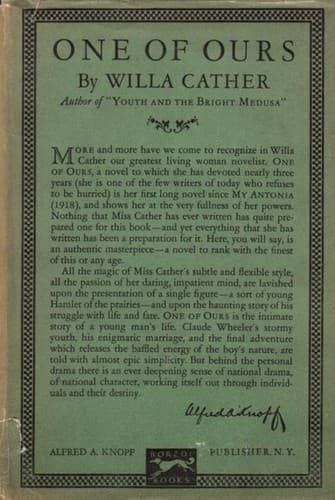
Farm life -- Fiction; Nebraska -- Fiction; Soldiers -- Fiction; War stories; World War, 1914-1918 -- Fiction
Claude started. "About what, Mother? Oh, the transportation! We
don't worry about that. It's the Government's job to get us
across. A soldier mustn't worry about anything except what he's
directly responsible for. If the Germans should sink a few troop
ships, it would be unfortunate, certainly, but it wouldn't cut any
figure in the long run. The British are perfecting an enormous
dirigible, built to carry passengers. If our transports are sunk,
it will only mean delay. In another year the Yankees will be
flying over. They can't stop us."
Mrs. Wheeler bent forward. "That must be boys' talk, Claude.
Surely you don't believe such a thing could be practicable?"
"Absolutely. The British are depending on their aircraft
designers to do just that, if everything else fails. Of course,
nobody knows yet how effective the submarines will be in our
case."
Mrs. Wheeler again shaded her eyes with her hand. "When I was
young, back in Vermont, I used to wish that I had lived in the
old times when the world went ahead by leaps and bounds. And now,
I feel as if my sight couldn't bear the glory that beats upon it.
It seems as if we would have to be born with new faculties, to
comprehend what is going on in the air and under the sea."
XII
The afternoon sun was pouring in at the back windows of Mrs.
Farmer's long, uneven parlour, making the dusky room look like a
cavern with a fire at one end of it. The furniture was all in its
cool, figured summer cretonnes. The glass flower vases that stood
about on little tables caught the sunlight and twinkled like tiny
lamps. Claude had been sitting there for a long while, and he
knew he ought to go. Through the window at his elbow he could see
rows of double hollyhocks, the flat leaves of the sprawling
catalpa, and the spires of the tangled mint bed, all transparent
in the gold-powdered light. They had talked about everything but
the thing he had come to say. As he looked out into the garden he
felt that he would never get it out. There was something in the
way the mint bed burned and floated that made one a
fatalist,--afraid to meddle. But after he was far away, he would
regret; uncertainty would tease him like a splinter in his thumb.
He rose suddenly and said without apology: "Gladys, I wish I
could feel sure you'd never marry my brother."
She did not reply, but sat in her easy chair, looking up at him
with a strange kind of calmness.
"I know all the advantages," he went on hastily, "but they
wouldn't make it up to you. That sort of a--compromise would make
you awfully unhappy. I know."
"I don't think I shall ever marry Bayliss," Gladys spoke in her
usual low, round voice, but her quick breathing showed he had
touched something that hurt. "I suppose I have used him. It gives
a school-teacher a certain prestige if people think she can marry
the rich bachelor of the town whenever she wants to. But I am
afraid I won't marry him,--because you are the member of the
family I have always admired."
Public-domain text, read in full here on John Shaqi.
Reviews
Reviews
No reviews yet
Be the first to share your thoughts on this work.
Elsewhere in the archive
Join the Discussion
Join the discussion
Sign in to leave a comment or review.
Sign InorCreate an account