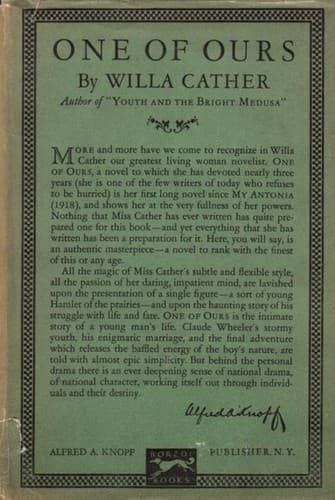
Farm life -- Fiction; Nebraska -- Fiction; Soldiers -- Fiction; War stories; World War, 1914-1918 -- Fiction
Claude turned away to the window. "A fine lot I've been to
admire," he muttered.
"Well, it's true, anyway. It was like that when we went to High
School, and it's kept up. Everything you do always seems exciting
to me."
Claude felt a cold perspiration on his forehead. He wished now
that he had never come. "But that's it, Gladys. What HAVE I ever
done, except make one blunder after another?"
She came over to the window and stood beside him. "I don't know;
perhaps it's by their blunders that one gets to know people,--by
what they can't do. If you'd been like all the rest, you could
have got on in their way. That was the one thing I couldn't have
stood."
Claude was frowning out into the flaming garden. He had not heard
a word of her reply. "Why didn't you keep me from making a fool
of myself?" he asked in a low voice.
"I think I tried--once. Anyhow, it's all turning out better than
I thought. You didn't get stuck here. You've found your place.
You're sailing away. You've just begun."
"And what about you?"
She laughed softly. "Oh, I shall teach in the High School!"
Claude took her hands and they stood looking searchingly at each
other in the swimming golden light that made everything
transparent. He never knew exactly how he found his hat and made
his way out of the house. He was only sure that Gladys did not
accompany him to the door. He glanced back once, and saw her head
against the bright window.
She stood there, exactly where he left her, and watched the
evening come on, not moving, scarcely breathing. She was thinking
how often, when she came downstairs, she would see him standing
here by the window, or moving about in the dusky room, looking at
last as he ought to look,--like his convictions and the choice he
had made. She would never let this house be sold for taxes now.
She would save her salary and pay them off. She could never like
any other room so well as this. It had always been a refuge from
Frankfort; and now there would be this vivid, confident figure,
an image as distinct to her as the portrait of her grandfather
upon the wall.
XIII
Sunday was Claude's last day at home, and he took a long walk
with Ernest and Ralph. Ernest would have preferred to lose
Ralph, but when the boy was out of the harvest field he stuck to
his brother like a burr. There was something about Claude's new
clothes and new manner that fascinated him, and he went through
one of those sudden changes of feeling that often occur in
families. Although they had been better friends ever since
Claude's wedding, until now Ralph had always felt a little
ashamed of him. Why, he used to ask himself, wouldn't Claude
"spruce up and be somebody"? Now, he was struck by the fact that
he was somebody.
Public-domain text, read in full here on John Shaqi.
Reviews
Reviews
No reviews yet
Be the first to share your thoughts on this work.
Elsewhere in the archive
Join the Discussion
Join the discussion
Sign in to leave a comment or review.
Sign InorCreate an account