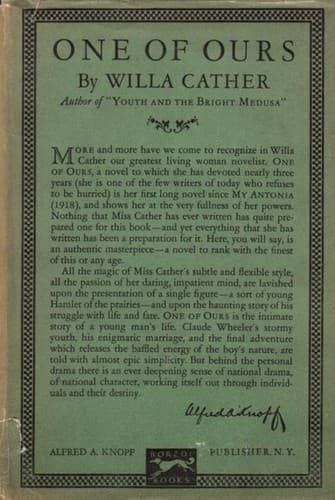
Farm life -- Fiction; Nebraska -- Fiction; Soldiers -- Fiction; War stories; World War, 1914-1918 -- Fiction
The company formed for roll-call at one end of the shed, with
their packs and rifles. Breakfast was served to them while they
waited. After an hour's standing on the concrete, they saw
encouraging signs. Two gangplanks were lowered from the vessel at
the end of the slip, and up each of them began to stream a close
brown line of men in smart service caps. They recognized a
company of Kansas Infantry, and began to grumble because their
own service caps hadn't yet been given to them; they would have
to sail in their old Stetsons. Soon they were drawn into one of
the brown lines that went continuously up the gangways, like
belting running over machinery. On the deck one steward directed
the men down to the hold, and another conducted the officers to
their cabins. Claude was shown to a four-berth state-room. One of
his cabin mates, Lieutenant Fanning, of his own company, was
already there, putting his slender luggage in order. The steward
told them the officers were breakfasting in the dining saloon.
By seven o'clock all the troops were aboard, and the men were
allowed on deck. For the first time Claude saw the profile of New
York City, rising thin and gray against an opal-coloured morning
sky. The day had come on hot and misty. The sun, though it was
now high, was a red ball, streaked across with purple clouds. The
tall buildings, of which he had heard so much, looked
unsubstantial and illusionary,--mere shadows of grey and pink and
blue that might dissolve with the mist and fade away in it. The
boys were disappointed. They were Western men, accustomed to the
hard light of high altitudes, and they wanted to see the city
clearly; they couldn't make anything of these uneven towers that
rose dimly through the vapour. Everybody was asking questions.
Which of those pale giants was the Singer Building? Which the
Woolworth? What was the gold dome, dully glinting through the
fog? Nobody knew. They agreed it was a shame they could not have
had a day in New York before they sailed away from it, and that
they would feel foolish in Paris when they had to admit they had
never so much as walked up Broadway. Tugs and ferry boats and
coal barges were moving up and down the oily river, all novel
sights to the men. Over in the Canard and French docks they saw
the first examples of the "camouflage" they had heard so much
about; big vessels daubed over in crazy patterns that made the
eyes ache, some in black and white, some in soft rainbow colours.
A tug steamed up alongside and fastened. A few moments later a
man appeared on the bridge and began to talk to the captain.
Young Fanning, who had stuck to Claude's side, told him this was
the pilot, and that his arrival meant they were going to start.
They could see the shiny instruments of a band assembling in the
bow.
Public-domain text, read in full here on John Shaqi.
Reviews
Reviews
No reviews yet
Be the first to share your thoughts on this work.
Elsewhere in the archive
Join the Discussion
Join the discussion
Sign in to leave a comment or review.
Sign InorCreate an account