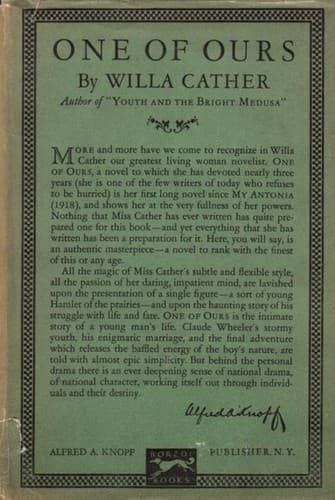
Farm life -- Fiction; Nebraska -- Fiction; Soldiers -- Fiction; War stories; World War, 1914-1918 -- Fiction
Three months later, on a grey December day, Claude was seated in
the passenger coach of an accommodation freight train, going home
for the holidays. He had a pile of books on the seat beside him
and was reading, when the train stopped with a jerk that sent the
volumes tumbling to the floor. He picked them up and looked at
his watch. It was noon. The freight would lie here for an hour or
more, until the east-bound passenger went by. Claude left the car
and walked slowly up the platform toward the station. A bundle of
little spruce trees had been flung off near the freight office,
and sent a smell of Christmas into the cold air. A few drays
stood about, the horses blanketed. The steam from the locomotive
made a spreading, deep-violet stain as it curled up against the
grey sky.
Claude went into a restaurant across the street and ordered an
oyster stew. The proprietress, a plump little German woman with a
frizzed bang, always remembered him from trip to trip. While he
was eating his oysters she told him that she had just finished
roasting a chicken with sweet potatoes, and if he liked he could
have the first brown cut off the breast before the train-men came
in for dinner. Asking her to bring it along, he waited, sitting
on a stool, his boots on the lead-pipe foot-rest, his elbows on
the shiny brown counter, staring at a pyramid of tough looking
bun-sandwiches under a glass globe.
"I been lookin' for you every day," said Mrs. Voigt when she
brought his plate. "I put plenty good gravy on dem sweet
pertaters, ja."
"Thank you. You must be popular with your boarders."
She giggled. "Ja, all de train men is friends mit me. Sometimes
dey bring me a liddle Schweizerkase from one of dem big saloons
in Omaha what de Cherman beobles batronize. I ain't got no boys
mein own self, so I got to fix up liddle tings for dem boys, eh?"
She stood nursing her stumpy hands under her apron, watching
every mouthful he ate so eagerly that she might have been tasting
it herself. The train crew trooped in, shouting to her and asking
what there was for dinner, and she ran about like an excited
little hen, chuckling and cackling. Claude wondered whether
working-men were as nice as that to old women the world over. He
didn't believe so. He liked to think that such geniality was
common only in what he broadly called "the West." He bought a big
cigar, and strolled up and down the platform, enjoying the fresh
air until the passenger whistled in.
After his freight train got under steam he did not open his books
again, but sat looking out at the grey homesteads as they
unrolled before him, with their stripped, dry cornfields, and the
great ploughed stretches where the winter wheat was asleep. A
starry sprinkling of snow lay like hoar-frost along the crumbly
ridges between the furrows.
Public-domain text, read in full here on John Shaqi.
Reviews
Reviews
No reviews yet
Be the first to share your thoughts on this work.
Join the Discussion
Join the discussion
Sign in to leave a comment or review.
Sign InorCreate an account