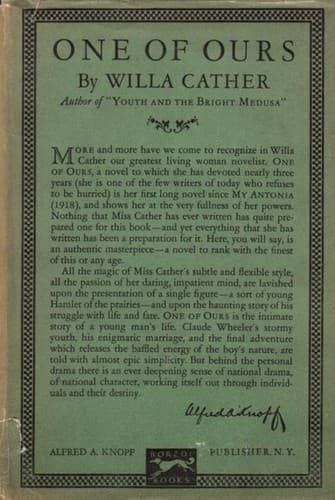
Farm life -- Fiction; Nebraska -- Fiction; Soldiers -- Fiction; War stories; World War, 1914-1918 -- Fiction
Claude nodded. David had come in, and was opening the shutters.
This officer, Claude was thinking, was a very different sort of
being from the poor prisoners they had been scooping up like
tadpoles from the cellars. One of the men picked up a gorgeous
silk dressing gown from the bed, another pointed to a
dressing-case full of hammered silver. Gerhardt said it was
Russian silver; this man must have come from the Eastern front.
Bert Fuller and Nifty Jones were going through the officer's
pockets. Claude watched them, and thought they did about right.
They didn't touch his medals; but his gold cigarette case, and
the platinum watch still ticking on his wrist,--he wouldn't have
further need for them. Around his neck, hung by a delicate chain,
was a miniature case, and in it was a painting,--not, as Bert
romantically hoped when he opened it, of a beautiful woman, but
of a young man, pale as snow, with blurred forget-me-not eyes.
Claude studied it, wondering. "It looks like a poet, or
something. Probably a kid brother, killed at the beginning of the
war."
Gerhardt took it and glanced at it with a disdainful expression.
"Probably. There, let him keep it, Bert." He touched Claude on
the shoulder to call his attention to the inlay work on the
handle of the officer's revolver.
Claude noticed that David looked at him as if he were very much
pleased with him,--looked, indeed, as if something pleasant had
happened in this room; where, God knew, nothing had; where, when
they turned round, a swarm of black flies was quivering with
greed and delight over the smears Willy Katz' body had left on
the floor. Claude had often observed that when David had an
interesting idea, or a strong twinge of recollection, it made
him, for the moment, rather heartless. Just now he felt that
Gerhardt's flash of high spirits was in some way connected with
him. Was it because he had gone in with Willy? Had David doubted
his nerve?
XVII
When the survivors of Company B are old men, and are telling over
their good days, they will say to each other, "Oh, that week we
spent at Beaufort!" They will close their eyes and see a little
village on a low ridge, lost in the forest, overgrown with oak
and chestnut and black walnut... buried in autumn colour, the
streets drifted deep in autumn leaves, great branches interlacing
over the roofs of the houses, wells of cool water that tastes of
moss and tree roots. Up and down those streets they will see
figures passing; themselves, young and brown and clean-limbed;
and comrades, long dead, but still alive in that far-away
village. How they will wish they could tramp again, nights on
days in the mud and rain, to drag sore feet into their old
billets at Beaufort! To sink into those wide feather beds and
sleep the round of the clock while the old women washed and dried
their clothes for them; to eat rabbit stew and pommes frites in
the garden,--rabbit stew made with red wine and chestnuts. Oh,
the days that are no more!
Public-domain text, read in full here on John Shaqi.
Reviews
Reviews
No reviews yet
Be the first to share your thoughts on this work.
Elsewhere in the archive
Join the Discussion
Join the discussion
Sign in to leave a comment or review.
Sign InorCreate an account