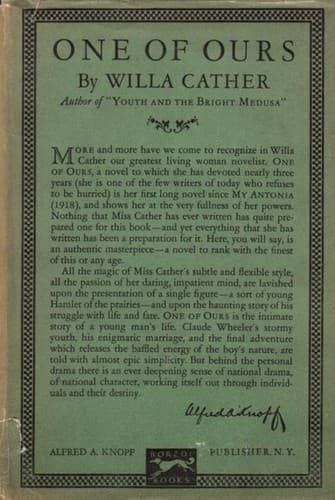
Farm life -- Fiction; Nebraska -- Fiction; Soldiers -- Fiction; War stories; World War, 1914-1918 -- Fiction
As soon as Captain Maxey and the wounded men had been started on
their long journey to the rear, carried by the prisoners, the
whole company turned in and slept for twelve hours--all but
Sergeant Hicks, who sat in the house off the square, beside the
body of his chum.
The next day the Americans came to life as if they were new men,
just created in a new world. And the people of the town came to
life... excitement, change, something to look forward to at
last! A new flag, le drapeau étoilé, floated along with the
tricolour in the square. At sunset the soldiers stood in
formation behind it and sang "The Star Spangled Banner" with
uncovered heads. The old people watched them from the doorways.
The Americans were the first to bring "Madelon" to Beaufort. The
fact that the village had never heard this song, that the
children stood round begging for it, "Chantez-vous la Madelon!"
made the soldiers realize how far and how long out of the world
these villagers had been. The German occupation was like a
deafness which nothing pierced but their own arrogant martial
airs.
Before Claude was out of bed after his first long sleep, a runner
arrived from Colonel Scott, notifying him that he was in charge
of the Company until further orders. The German prisoners had
buried their own dead and dug graves for the Americans before
they were sent off to the rear. Claude and David were billeted at
the edge of the town, with the woman who had given Captain Maxey
his first information, when they marched in yesterday morning.
Their hostess told them, at their mid-day breakfast, that the old
dame who was shot in the square, and the little girl, were to be
buried this afternoon. Claude decided that the Americans might as
well have their funeral at the same time. He thought he would ask
the priest to say a prayer at the graves, and he and David set
off through the brilliant, rustling autumn sunshine to find the
Cure's house. It was next the church, with a high-walled garden
behind it. Over the bell-pull in the outer wall was a card on
which was written, "Tirez fort."
The priest himself came out to them, an old man who seemed weak
like his doorbell. He stood in his black cap, holding his hands
against his breast to keep them from shaking, and looked very old
indeed,--broken, hopeless, as if he were sick of this world and
done with it. Nowhere in France had Claude seen a face so sad as
his. Yes, he would say a prayer. It was better to have Christian
burial, and they were far from home, poor fellows! David asked
him whether the German rule had been very oppressive, but the old
man did not answer clearly, and his hands began to shake so
uncontrollably over his cassock that they went away to spare him
embarrassment.
"He seems a little gone in the head, don't you think?" Claude
remarked.
Public-domain text, read in full here on John Shaqi.
Reviews
Reviews
No reviews yet
Be the first to share your thoughts on this work.
Elsewhere in the archive
Join the Discussion
Join the discussion
Sign in to leave a comment or review.
Sign InorCreate an account