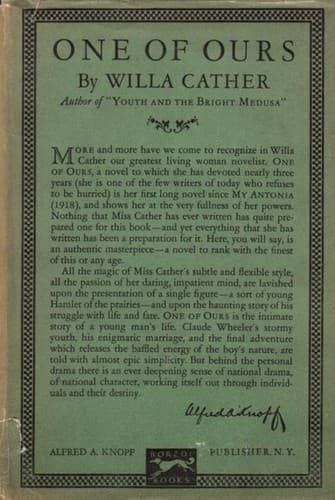
Farm life -- Fiction; Nebraska -- Fiction; Soldiers -- Fiction; War stories; World War, 1914-1918 -- Fiction
Ernest was sympathetic now. He drew nearer to Claude as they
walked along and looked at him sidewise with concern. "You
Americans are always looking for something outside yourselves to
warm you up, and it is no way to do. In old countries, where not
very much can happen to us, we know that,--and we learn to make
the most of little things."
"The martyrs must have found something outside themselves.
Otherwise they could have made themselves comfortable with little
things."
"Why, I should say they were the ones who had nothing but their
idea! It would be ridiculous to get burned at the stake for the
sensation. Sometimes I think the martyrs had a good deal of
vanity to help them along, too."
Claude thought Ernest had never been so tiresome. He squinted at
a bright object across the fields and said cuttingly, "The fact
is, Ernest, you think a man ought to be satisfied with his board
and clothes and Sundays off, don't you?"
Ernest laughed rather mournfully. "It doesn't matter much what I
think about it; things are as they are. Nothing is going to reach
down from the sky and pick a man up, I guess."
Claude muttered something to himself, twisting his chin about
over his collar as if he had a bridle-bit in his mouth.
The sun had dropped low, and the two boys, as Mrs. Wheeler
watched them from the kitchen window, seemed to be walking beside
a prairie fire. She smiled as she saw their black figures moving
along on the crest of the hill against the golden sky; even at
that distance the one looked so adaptable, and the other so
unyielding. They were arguing, probably, and probably Claude was
on the wrong side.
IX
After the vacation Claude again settled down to his reading in
the University Library. He worked at a table next the alcove
where the books on painting and sculpture were kept. The art
students, all of whom were girls, read and whispered together in
this enclosure, and he could enjoy their company without having
to talk to them. They were lively and friendly; they often asked
him to lift heavy books and portfolios from the shelves, and
greeted him gaily when he met them in the street or on the
campus, and talked to him with the easy cordiality usual between
boys and girls in a co-educational school. One of these girls,
Miss Peachy Millmore, was different from the others,--different
from any girl Claude had ever known. She came from Georgia, and
was spending the winter with her aunt on B street.
Public-domain text, read in full here on John Shaqi.
Reviews
Reviews
No reviews yet
Be the first to share your thoughts on this work.
Join the Discussion
Join the discussion
Sign in to leave a comment or review.
Sign InorCreate an account