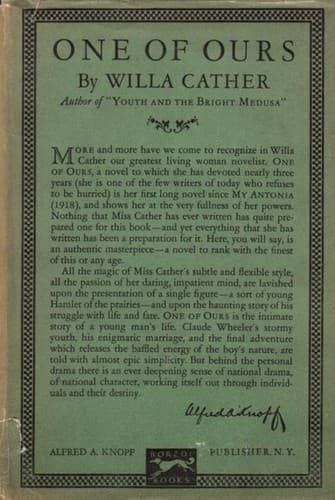
Farm life -- Fiction; Nebraska -- Fiction; Soldiers -- Fiction; War stories; World War, 1914-1918 -- Fiction
Claude went to bed immediately after supper, but he had no sooner
stretched his aching body between the sheets than he began to
feel wakeful. He was humiliated at losing the pigs, because they
had been left in his charge; but for the loss in money, about
which even his mother was grieved, he didn't seem to care. He
wondered whether all that winter he hadn't been working himself
up into a childish contempt for money-values.
When Ralph was home at Christmas time, he wore on his little
finger a heavy gold ring, with a diamond as big as a pea,
surrounded by showy grooves in the metal. He admitted to Claude
that he had won it in a poker game. Ralph's hands were never free
from automobile grease--they were the red, stumpy kind that
couldn't be kept clean. Claude remembered him milking in the barn
by lantern light, his jewel throwing off jabbing sparkles of
colour, and his fingers looking very much like the teats of the
cow. That picture rose before him now, as a symbol of what
successful farming led to.
The farmer raised and took to market things with an intrinsic
value; wheat and corn as good as could be grown anywhere in the
world, hogs and cattle that were the best of their kind. In
return he got manufactured articles of poor quality; showy
furniture that went to pieces, carpets and draperies that faded,
clothes that made a handsome man look like a clown. Most of his
money was paid out for machinery,--and that, too, went to pieces.
A steam thrasher didn't last long; a horse outlived three
automobiles.
Claude felt sure that when he was a little boy and all the
neighbours were poor, they and their houses and farms had more
individuality. The farmers took time then to plant fine
cottonwood groves on their places, and to set osage orange hedges
along the borders of their fields. Now these trees were all being
cut down and grubbed up. Just why, nobody knew; they impoverished
the land... they made the snow drift... nobody had them any
more. With prosperity came a kind of callousness; everybody
wanted to destroy the old things they used to take pride in. The
orchards, which had been nursed and tended so carefully twenty
years ago, were now left to die of neglect. It was less trouble
to run into town in an automobile and buy fruit than it was to
raise it.
The people themselves had changed. He could remember when all the
farmers in this community were friendly toward each other; now
they were continually having lawsuits. Their sons were either
stingy and grasping, or extravagant and lazy, and they were
always stirring up trouble. Evidently, it took more intelligence
to spend money than to make it.
When he pondered upon this conclusion, Claude thought of the
Erlichs. Julius could go abroad and study for his doctor's
degree, and live on less than Ralph wasted every year. Ralph
would never have a profession or a trade, would never do or make
anything the world needed.
Public-domain text, read in full here on John Shaqi.
Reviews
Reviews
No reviews yet
Be the first to share your thoughts on this work.
Elsewhere in the archive
Join the Discussion
Join the discussion
Sign in to leave a comment or review.
Sign InorCreate an account