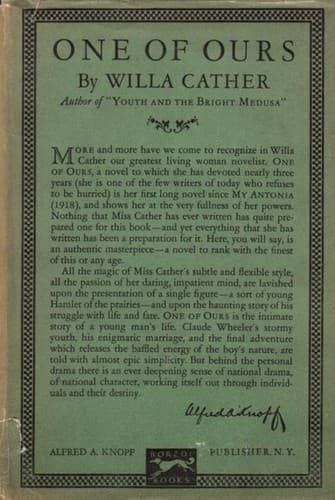
Farm life -- Fiction; Nebraska -- Fiction; Soldiers -- Fiction; War stories; World War, 1914-1918 -- Fiction
Nor did Claude find his own outlook much better. He was
twenty-one years old, and he had no skill, no training,--no
ability that would ever take him among the kind of people he
admired. He was a clumsy, awkward farmer boy, and even Mrs.
Erlich seemed to think the farm the best place for him. Probably
it was; but all the same he didn't find this kind of life worth
the trouble of getting up every morning. He could not see the use
of working for money, when money brought nothing one wanted. Mrs.
Erlich said it brought security. Sometimes he thought this
security was what was the matter with everybody; that only
perfect safety was required to kill all the best qualities in
people and develop the mean ones.
Ernest, too, said "it's the best life in the world, Claude."
But if you went to bed defeated every night, and dreaded to wake
in the morning, then clearly it was too good a life for you. To
be assured, at his age, of three meals a day and plenty of sleep,
was like being assured of a decent burial. Safety, security; if
you followed that reasoning out, then the unborn, those who would
never be born, were the safest of all; nothing could happen to
them.
Claude knew, and everybody else knew, seemingly, that there was
something wrong with him. He had been unable to conceal his
discontent. Mr. Wheeler was afraid he was one of those visionary
fellows who make unnecessary difficulties for themselves and
other people. Mrs. Wheeler thought the trouble with her son was
that he had not yet found his Saviour. Bayliss was convinced that
his brother was a moral rebel, that behind his reticence and his
guarded manner he concealed the most dangerous opinions. The
neighbours liked Claude, but they laughed at him, and said it was
a good thing his father was well fixed. Claude was aware that his
energy, instead of accomplishing something, was spent in
resisting unalterable conditions, and in unavailing efforts to
subdue his own nature. When he thought he had at last got himself
in hand, a moment would undo the work of days; in a flash he
would be transformed from a wooden post into a living boy. He
would spring to his feet, turn over quickly in bed, or stop short
in his walk, because the old belief flashed up in him with an
intense kind of hope, an intense kind of pain,--the conviction
that there was something splendid about life, if he could but
find it.
IX
Public-domain text, read in full here on John Shaqi.
Reviews
Reviews
No reviews yet
Be the first to share your thoughts on this work.
Elsewhere in the archive
Join the Discussion
Join the discussion
Sign in to leave a comment or review.
Sign InorCreate an account