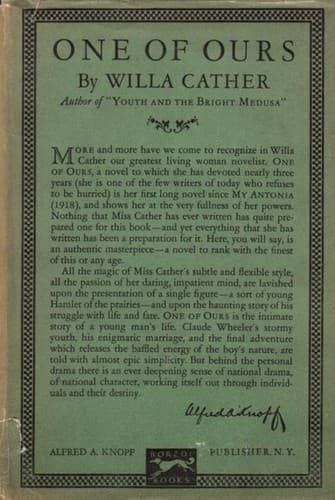
Farm life -- Fiction; Nebraska -- Fiction; Soldiers -- Fiction; War stories; World War, 1914-1918 -- Fiction
Jason Royce must have kept his mill going out of sentiment, for
there was not much money in it now. But milling had been his
first business, and he had not found many things in life to be
sentimental about. Sometimes one still came upon him in dusty
miller's clothes, giving his man a day off. He had long ago
ceased to depend on the risings and fallings of Lovely Creek for
his power, and had put in a gasoline engine. The old dam now lay
"like a holler tooth," as one of his men said, grown up with
weeds and willow-brush.
Mr. Royce's family affairs had never gone as well as his
business. He had not been blessed with a son, and out of five
daughters he had succeeded in bringing up only two. People
thought the mill house damp and unwholesome. Until he built a
tenant's cottage and got a married man to take charge of the
mill, Mr. Royce was never able to keep his millers long. They
complained of the gloom of the house, and said they could not get
enough to eat. Mrs. Royce went every summer to a vegetarian
sanatorium in Michigan, where she learned to live on nuts and
toasted cereals. She gave her family nourishment, to be sure, but
there was never during the day a meal that a man could look
forward to with pleasure, or sit down to with satisfaction. Mr.
Royce usually dined at the hotel in town. Nevertheless, his wife
was distinguished for certain brilliant culinary accomplishments.
Her bread was faultless. When a church supper was toward, she was
always called upon for her wonderful mayonnaise dressing, or her
angel-food cake,--sure to be the lightest and spongiest in any
assemblage of cakes.
A deep preoccupation about her health made Mrs. Royce like a
woman who has a hidden grief, or is preyed upon by a consuming
regret. It wrapped her in a kind of insensibility. She lived
differently from other people, and that fact made her distrustful
and reserved. Only when she was at the sanatorium, under the care
of her idolized doctors, did she feel that she was understood and
surrounded by sympathy.
Her distrust had communicated itself to her daughters and in
countless little ways had coloured their feelings about life.
They grew up under the shadow of being "different," and formed no
close friendships. Gladys Farmer was the only Frankfort girl who
had ever gone much to the mill house. Nobody was surprised when
Caroline Royce, the older daughter, went out to China to be a
missionary, or that her mother let her go without a protest. The
Royce women were strange, anyhow, people said; with Carrie gone,
they hoped Enid would grow up to be more like other folk. She
dressed well, came to town often in her car, and was always ready
to work for the church or the public library.
Public-domain text, read in full here on John Shaqi.
Reviews
Reviews
No reviews yet
Be the first to share your thoughts on this work.
Elsewhere in the archive
Join the Discussion
Join the discussion
Sign in to leave a comment or review.
Sign InorCreate an account