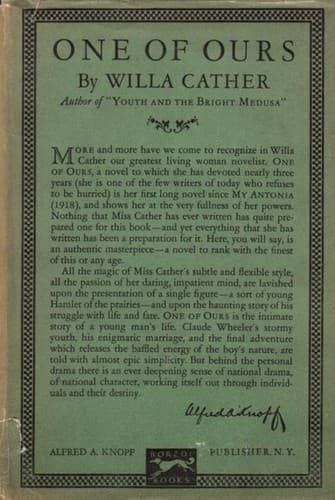
Farm life -- Fiction; Nebraska -- Fiction; Soldiers -- Fiction; War stories; World War, 1914-1918 -- Fiction
The horses stood with their heads over the wagon-box, munching
their oats. The stream trickled by under the willow roots with a
cool, persuasive sound. Claude and Ernest lay in the shade, their
coats under their heads, talking very little. Occasionally a
motor dashed along the road toward town, and a cloud of dust and
a smell of gasoline blew in over the creek bottom; but for the
most part the silence of the warm, lazy summer noon was
undisturbed. Claude could usually forget his own vexations and
chagrins when he was with Ernest. The Bohemian boy was never
uncertain, was not pulled in two or three ways at once. He was
simple and direct. He had a number of impersonal preoccupations;
was interested in politics and history and in new inventions.
Claude felt that his friend lived in an atmosphere of mental
liberty to which he himself could never hope to attain. After he
had talked with Ernest for awhile, the things that did not go
right on the farm seemed less important. Claude's mother was
almost as fond of Ernest as he was himself. When the two boys
were going to high school, Ernest often came over in the evening
to study with Claude, and while they worked at the long kitchen
table Mrs. Wheeler brought her darning and sat near them, helping
them with their Latin and algebra. Even old Mahailey was
enlightened by their words of wisdom.
Mrs. Wheeler said she would never forget the night Ernest arrived
from the Old Country. His brother, Joe Havel, had gone to
Frankfort to meet him, and was to stop on the way home and leave
some groceries for the Wheelers. The train from the east was
late; it was ten o'clock that night when Mrs. Wheeler, waiting in
the kitchen, heard Havel's wagon rumble across the little bridge
over Lovely Creek. She opened the outside door, and presently Joe
came in with a bucket of salt fish in one hand and a sack of
flour on his shoulder. While he took the fish down to the cellar
for her, another figure appeared in the doorway; a young boy,
short, stooped, with a flat cap on his head and a great oilcloth
valise, such as pedlars carry, strapped to his back. He had
fallen asleep in the wagon, and on waking and finding his brother
gone, he had supposed they were at home and scrambled for his
pack. He stood in the doorway, blinking his eyes at the light,
looking astonished but eager to do whatever was required of him.
What if one of her own boys, Mrs. Wheeler thought.... She
went up to him and put her arm around him, laughing a little and
saying in her quiet voice, just as if he could understand her,
"Why, you're only a little boy after all, aren't you?"
Ernest said afterwards that it was his first welcome to this
country, though he had travelled so far, and had been pushed and
hauled and shouted at for so many days, he had lost count of
them. That night he and Claude only shook hands and looked at
each other suspiciously, but ever since they had been good
friends.
Public-domain text, read in full here on John Shaqi.
Reviews
Reviews
No reviews yet
Be the first to share your thoughts on this work.
Join the Discussion
Join the discussion
Sign in to leave a comment or review.
Sign InorCreate an account