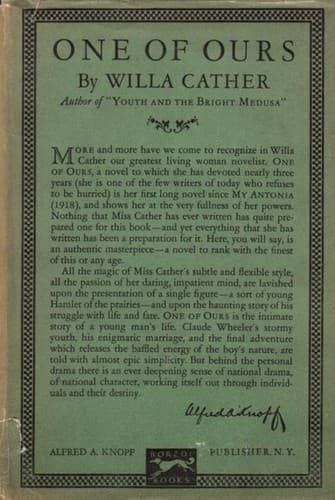
Farm life -- Fiction; Nebraska -- Fiction; Soldiers -- Fiction; War stories; World War, 1914-1918 -- Fiction
One evening Mr. Wheeler came down to supper with a bundle of
newspapers under his arm. "Claude, I see this war scare in Europe
has hit the market. Wheat's taken a jump. They're paying
eighty-eight cents in Chicago. We might as well get rid of a few
hundred bushel before it drops again. We'd better begin hauling
tomorrow. You and I can make two trips a day over to Vicount, by
changing teams,--there's no grade to speak of."
Mrs. Wheeler, arrested in the act of pouring coffee, sat holding
the coffee-pot in the air, forgetting she had it. "If this is
only a newspaper scare, as we think, I don't see why it should
affect the market," she murmured mildly. "Surely those big
bankers in New York and Boston have some way of knowing rumour
from fact."
"Give me some coffee, please," said her husband testily. "I don't
have to explain the market, I've only got to take advantage of
it."
"But unless there's some reason, why are we dragging our wheat
over to Vicount? Do you suppose it's some scheme the grain men
are hiding under a war rumour? Have the financiers and the press
ever deceived the public like this before?"
"I don't know a thing in the world about it, Evangeline, and I
don't suppose. I telephoned the elevator at Vicount an hour ago,
and they said they'd pay me seventy cents, subject to change in
the morning quotations. Claude," with a twinkle in his eye,
"you'd better not go to mill tonight. Turn in early. If we are on
the road by six tomorrow, we'll be in town before the heat of the
day."
"All right, sir. I want to look at the papers after supper. I
haven't read anything but the headlines since before thrashing.
Ernest was stirred up about the murder of that Grand Duke and
said the Austrians would make trouble. But I never thought there
was anything in it."
"There's seventy cents a bushel in it, anyway," said his father,
reaching for a hot biscuit.
"If there's that much, I'm somehow afraid there will be more,"
said Mrs. Wheeler thoughtfully. She had picked up the paper
fly-brush and sat waving it irregularly, as if she were trying to
brush away a swarm of confusing ideas.
"You might call up Ernest, and ask him what the Bohemian papers
say about it," Mr. Wheeler suggested.
Claude went to the telephone, but was unable to get any answer
from the Havels. They had probably gone to a barn dance down in
the Bohemian township. He went upstairs and sat down before an
armchair full of newspapers; he could make nothing reasonable
out of the smeary telegrams in big type on the front page of the
Omaha World Herald. The German army was entering Luxembourg; he
didn't know where Luxembourg was, whether it was a city or a
country; he seemed to have some vague idea that it was a palace!
His mother had gone up to "Mahailey's library," the attic, to
hunt for a map of Europe,--a thing for which Nebraska farmers had
never had much need. But that night, on many prairie homesteads,
the women, American and foreign-born, were hunting for a map.
Public-domain text, read in full here on John Shaqi.
Reviews
Reviews
No reviews yet
Be the first to share your thoughts on this work.
Elsewhere in the archive
Join the Discussion
Join the discussion
Sign in to leave a comment or review.
Sign InorCreate an account